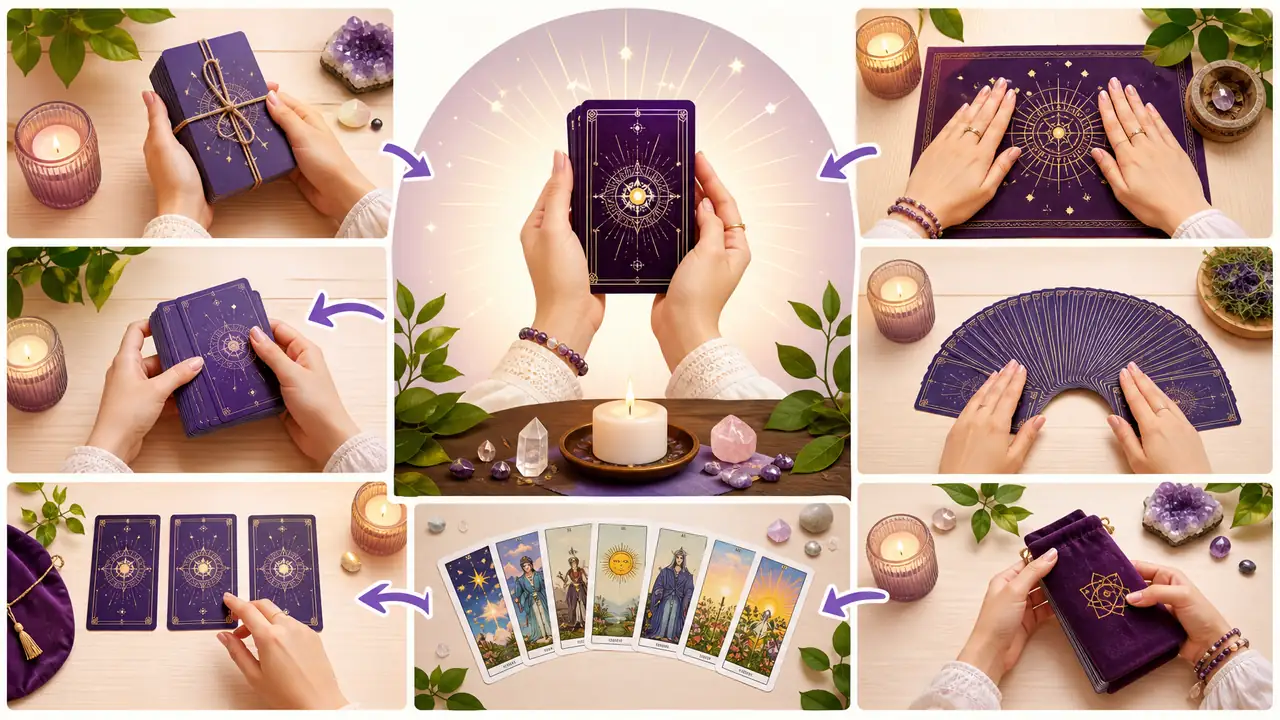
A tarot deck opening ritual can be simple: check that the deck is complete, clear your table, shuffle and cut, look through the cards one by one, set boundaries for how you'll use them, then draw a small spread asking “How will I work with this deck?” A fancier ritual doesn't make the deck work better. What matters is knowing what you'll use the deck for, what you won't ask it, and how you'll record each reading.
An opening ritual helps when you get a brand-new deck, return to a deck you haven't used in a long time, want a fresh start after lending it out, or want to turn a collector's deck into one you read with. Below we cover mindset and tools, the seven steps of opening a deck, how to practice afterwards, and which popular claims you can safely ignore.
If your deck has full scenes on the Minor Arcana too, treat the ritual as a way of getting to know the cards rather than consecrating them. Every card in that kind of deck shows a concrete scene, which makes it ideal for building intuition and judgment through observation, journaling and practice draws.
Key takeaways: opening a deck needs no incantation and no special hour. The core is checking the cards, writing down your purpose and boundaries, drawing an opening spread and recording it. Pulling The Tower or Death doesn't mean the deck isn't right for you. If someone else has handled your cards, putting them back in order, shuffling and restating your purpose is usually enough.
Start with the right mindset: opening a deck is about connection, not superstition
The first step in learning tarot isn't memorizing all seventy-eight cards or finding the most mysterious opening incantation. It's deciding how you'll use this deck. The point of an opening ritual is practical: it turns a new deck from an unfamiliar object into a reading tool you can use with confidence. You'll want to get to know its art style, its feel in your hands, the card backs and how it shuffles. You'll also want to set some ground rules for your questions: don't treat the cards as orders, don't use them to dodge your own choices, and don't keep pressing them on the same issue.
Many beginners picture opening a deck as a one-time magic act, as if skipping a single step will make the whole deck inaccurate, or as if drawing a certain Major Arcana card locks them into a fixed fate. That kind of thinking breeds anxiety and actually weakens your reading. Tarot traditions do involve ritual, symbolism and intuition training, but ritual mainly helps you focus, set boundaries and settle into an observant state. If you want a fuller learning path from scratch, pair this with the ultimate tarot guide for beginners and treat opening your deck as the start of that journey.
Opening a deck isn't blessing it or fixing its fate
Deck opening often gets described in mystical terms, but for beginners the safest way to see it is as the first official use. In a quiet space, you can tell yourself: this deck will help me sort through questions, see my options and notice what's going on inside me, not decide my life for me. That statement means more than any memorized formula, because it shapes how you'll ask questions from then on. When you treat tarot as a tool for reflection, a single card won't send you into fear, and you'll find it easier to spot actions you can adjust.
A steady mindset makes your first reading steadier
On the day you open your deck, avoid diving straight into high-anxiety, outcome-focused questions or ones that pry into a third party's privacy, like “Will they definitely come back?” or “Am I destined to fail?” You don't know the deck yet, and you haven't built a feel for reading it, so questions like these only amplify worry. Start with practice questions instead: How will I work with this deck? What should I watch for as I learn tarot? Which reading skill is best to develop right now?
- The purpose of opening a deck: build focus, get familiar with the cards, set boundaries for their use.
- Don't treat the ritual as a secret procedure that guarantees accuracy.
- Make your first questions about self-awareness and learning, not big outcomes.
What to prepare: your table, the cards, a journal and setting the mood
You don't need much before opening a deck, but each item should have a purpose. First, a clean, flat, well-lit surface so you can see every detail on the cards. Second, the deck itself: check for missing or duplicate cards, printing errors and damaged corners. Third, a notebook or digital log to record the date, the cards you drew, how you felt and what you notice later. Fourth, optional cleansing items like a white cloth, a candle, incense, crystals or a glass of water. None of these are sacred requirements. They simply help you shift into the right frame of mind.
When gathering tools, more isn't better. What counts is whether you can repeat the routine. If you live in a dorm, a rental or with family, you may not be able to burn incense or candles. Wiping down the table, washing your hands, taking a few deep breaths or playing calm music can settle you just as well. The biggest risk with an opening ritual is getting so attached to the form that a missing item keeps you from starting at all. What you really need is a routine you can keep up long term, not one elaborate setup you'll never repeat.
The basic toolkit
The essentials: a complete tarot deck, a clean cloth, a journal, a pen and some uninterrupted time. A cloth protects the cards and marks a mental boundary for the ritual. The journal is the tool beginners most often skip, and the most valuable one. Write down your question before you draw, your first impression of each card, what you added after checking a book, and what you understand differently when you look back a few days later. Over time this builds your own reading style far better than memorizing meanings.
Optional tools and their limits
Candles, incense, bells, sea salt, crystals and moonlight are all optional, and you don't need them all. If you believe in energy clearing, use them as symbols for tidying your space. If you prefer a rational approach, treat them as focusing rituals. Just don't let them become a source of pressure, and don't decide the deck can't be used because you're missing something. A tarot deck really comes alive the moment you start observing, asking, recording and refining your readings.
- Essentials: the deck, a table, a journal, quiet time.
- Optional: scent, candles, cloth, bells, crystals — they help you focus.
- Checking that the deck is complete matters more than an elaborate setup.
Learn the basics of tarot first so the ritual isn't empty
Before opening your deck, you should at least know that tarot is made up of the Major Arcana and the Minor Arcana. The Major Arcana tends to deal with life themes, psychological stages and major turning points. The Minor Arcana is closer to everyday events, emotional exchanges, how resources get shared out and habits of action. If you don't know the structure at all, any card you draw after opening will be pure guesswork, and it's easy to read symbols far too dramatically.
Decks with fully illustrated Minor Arcana suit beginners because even the pip cards show concrete scenes, not just rows of symbols. When opening your deck, flip quickly through all seventy-eight cards. Don't rush to memorize meanings. Notice which images draw you in, which make you uneasy, and which figures have especially striking directions or gestures. For the full set of meanings, see the complete guide to all 78 tarot card meanings.
See the Major Arcana as a journey
The Major Arcana runs from The Fool to The World and is often read as a symbolic journey of growth. If a Major Arcana card comes up as your significator when opening the deck, there's no need to read it as a lifelong mission. Ask instead: what kind of lesson is this deck asking me to face first as I learn tarot? The High Priestess might point to quiet observation and trusting intuition. Strength might suggest you don't need to rush to prove how accurate you are. Temperance might ask you to blend intuition with study. To go deeper, read the complete guide to the 22 Major Arcana cards.
The Minor Arcana keeps it grounded
The Minor Arcana has four suits: Wands, Cups, Swords and Pentacles, generally linked to action, emotion, thought and material life. Drawing a Minor Arcana card when you open the deck doesn't make the deck weaker or mean you lack spiritual talent. If anything, these cards remind you to start with daily practice. The Two of Wands suits planning a study rhythm, the Six of Cups invites a beginner's simple curiosity, the Eight of Swords warns against getting trapped by rules, and the Three of Pentacles suggests building skill through practice and feedback.
- Know the basic structure of the 78 cards before opening the deck.
- The Major Arcana shows themes; the Minor Arcana shows daily practice.
- The visual clues on each card are perfect for getting to know the deck.
The full opening ritual: cleaning, shuffling, stating your intention and drawing a significator
When you're ready, follow these seven steps:
1. Clear your table and wash your hands.
2. Unwrap the deck and check that all 78 cards are there.
3. Spread the cards out in order or look through them in batches, noticing the images and how they feel.
4. Knock on the deck, or clear it symbolically in whatever way you prefer.
5. State your purpose for the deck in your own words.
6. Shuffle and draw one to three cards as your opening spread.
7. Write it all down, without rushing to settle each card's final meaning.
That's a complete ritual. There's no need for a more complicated fixed formula.
Your statement can be plain, for example: “I'll use this deck to help me clarify questions, see my options and face my blind spots honestly. I won't ask it to control other people, and I won't treat it as the only answer.” That one sentence covers both purpose and boundaries. You might add: “When I'm too emotionally overwhelmed, I'll pause before reading.” This keeps you from falling into repeated readings right after opening the deck.
The single significator card
If you'd like to draw a significator, shuffle and ask: “What's the best way for this deck to support my learning right now?” One card is enough. It isn't the deck's permanent personality, just the strongest signal in this first meeting. The Hermit might suggest slow self-study and careful notes. The Lovers might mean you need to practice choosing between different interpretations. The Page of Swords might mean this deck will push you to ask more, check more and break things down.
A three-card opening spread
For a fuller version, use three cards: the first is “where I am in my learning,” the second is “how this deck can help me,” and the third is “the boundaries I should keep when using it.” Say the first card is the Eight of Pentacles: steady practice is your path. The second is The Moon: the deck can help you recognize hazy emotions and the subconscious. The third is The Devil: a reminder not to let readings turn into dependence, obsession or control. This kind of spread teaches you far more than asking “Is this deck accurate?”
How to journal your opening
Your notes don't need to be eloquent, but they should be useful to revisit. Record the date, the deck, your surroundings, your state before drawing, the question, card names, upright or reversed, the first image that caught your eye, what you added after looking up meanings, and one small action you plan to take. When you reread them later, you'll see which readings were intuitive hits, which were emotional projection and which were textbook recitation. This is what turns opening a deck from a ritual into real skill-building.
- One significator builds a quick connection; a three-card spread helps beginners find direction.
- Focus your statement on purpose and boundaries; there's no need to copy an unfamiliar voice.
- Always journal after opening the deck, or you'll struggle to track your growth.
Try free online tarot practice: building a feel for the cards without guessing
The most common thing after opening a deck is that beginners excitedly draw again and again, with no way to tell whether they read correctly. This is where free online practice resources, digital card meaning references and published sample spreads help alongside your physical deck. The goal isn't to let online tools read for you, but to check whether you missed visual details, card order, reversals or the context of the question. Write your own interpretation first, then compare it with other sources, rather than jumping straight to the answer after each draw.
The most effective practice is “short questions, short spreads, checkable results.” For example: What's my learning focus today? What should I watch for when talking with coworkers today? What's my emotional blind spot in this relationship? You won't have to wait years to see how these play out, and they won't trap you in fate-style answers. If you use online reading tools, keep your own notes too. Don't just screenshot without thinking or reviewing. Tools offer reference points, but what really sharpens your tarot reading is your ongoing ability to refine your questions and interpretations.
What free practice is good for
Free practice is best for learning spread positions, cross-checking keywords and testing how different wording changes a reading. Take a love question: “Will they like me?” and “How can I tell whether this connection is worth investing in?” lead to completely different readings. The first leaves you waiting on someone else's answer. The second shows you your boundaries, signs to watch for and your next step. Practice like this after opening your deck and you'll build mature questioning habits faster.
Don't treat online practice as the final word
Online reading tools organize an interpretation around the question you type, but they only know what you tell them, and they can't take responsibility for what you do next. So if an online reading differs from your intuition, don't dismiss yourself right away. Go back to the card and ask three things: What's the visual focus of this card? What role does it play in its position? What concrete action is it nudging me toward? This keeps practice from becoming passive answer-collecting.
- Read it yourself first, then check online sources; you'll learn more.
- Keep practice questions short, clear and easy to revisit soon.
- Online tools help with cross-checking but shouldn't replace your own judgment.
Tarot essentials: build a reading framework from imagery, elements and reversals
Many beginners choose a deck with a full scene on every card for their first purchase, since the images are clear, learning resources are plentiful and the scenes tell stories you can follow. When opening the deck, the most useful thing isn't memorizing every meaning but practicing how to read the people, objects, directions, colors, distances and actions in each image. Is the figure looking into the distance, turning away from others, holding a tool, standing steady? These details give you first clues and take your readings beyond keywords.
Handle reversals carefully, too. Beginners often assume a reversed card means something bad, but reversals can indicate delay, internalization, blockage, excess, lack or a need to readjust. If you're not comfortable with reversals yet, you can read only upright cards for the first month and add reversals once you know the images. Or keep them, but each time ask only what imbalance they're pointing to. For a fuller picture of the deck, pair this with the complete tarot tutorial for beginners and learn theory and practice side by side.
Read the image first, then refine with meanings
Take the Five of Cups. If you've only memorized the word “loss,” your reading will be thin. Look at the image, though, and you'll see the figure staring at spilled cups while two cups still stand behind them, with a bridge and buildings in the distance. Grief is present, but not every resource is gone. As you practice with your new deck, write three observations for each card: What do I see? What do I feel? What might I be missing? When you then look up the meaning, you'll know which clues came from the image and which from tradition.
Elements and numbers make the Minor Arcana easier
Wands are generally linked to passion and action, Cups to emotions and feelings, Swords to thought and conflict, and Pentacles to resources and physical life. Numbers show stages of development: one is a beginning, two is choice or balance, three is collaboration or expansion, ten is completion or burden. If you draw a daily card after opening your deck, note both element and number. This works better than memorizing 78 cards in isolation and helps you build a reading framework quickly.
- Beginners do well with fully illustrated decks; there's no need to chase obscure systems right away.
- A reversal isn't automatically bad; it often signals imbalance or a need to adjust.
- Combining elements, numbers and imagery makes your readings steadier fast.
Practice real readings after opening your deck to find your interpretive voice
Once your deck is open, don't rush into big readings for all your friends. A better order is to start with a daily card for yourself, move on to three-card spreads, and only then try short questions for people you know well. For a daily card, ask “What should I pay attention to today?” and note in the evening whether anything matched. For three cards, try “situation, obstacle, advice” or “past, present, possible direction.” These simple layouts train you to read each card in its position rather than reciting keywords.
A feel for interpreting tarot comes from three things: a clear question, careful observation of the cards and a link to your real situation. Say the question is “Where am I stuck in learning tarot?” and you draw the Nine of Swords, the Eight of Pentacles and Temperance. Stopping at “You're anxious, work hard, find balance” isn't enough. A fuller reading: the Nine of Swords shows you've internalized study pressure and may lie awake worrying you're not good enough; the Eight of Pentacles suggests replacing anxious research with steady practice; Temperance reminds you to find a balance between intuition and books, without trying to master everything at once. That's a reading you can act on.
A beginner's three-card example
Question: “How can I build a steady working relationship with this new deck?” The first card, current state, is the Page of Wands: you're excited and curious, but your experience is just beginning. The second, how the deck can help, is The High Priestess: this deck can train you to observe quietly and not rush to speak. The third, boundaries, is the Five of Swords: don't use tarot to win arguments, prove you know more than others or force answers in the middle of emotional conflict. This reading offers both encouragement and caution.
Set the ground rules before reading for others
When you start practicing on friends, first explain that you're a beginner, that the reading is for reflection only, that it can't replace medical, legal or financial advice, and that you can't promise any outcome. Reframe questions so they're actionable: turn “Will they come back?” into “How can I handle the uncertainty in this relationship?” and “Will I definitely get the job?” into “What should I strengthen most before the interview?” This protects the other person and keeps you from being weighed down by pressure over outcomes.
- Start with a daily card, then three-card spreads, and only then read for others.
- A good reading names the visual clues, the question's context and concrete advice.
- Explain the limits before reading for anyone, so expectations don't overwhelm you.
Common myths and boundaries: deck-opening claims you can safely ignore
The most common myth about opening a deck is that it only works under a certain moon phase, at a certain time, facing a certain direction or with a certain incantation. These can be personal ritual preferences, but they shouldn't become rules that scare beginners. Another myth is that drawing a significator you dislike means the deck isn't right for you. The Tower isn't necessarily a disaster; it may suggest the deck will help you tear down old assumptions. Death isn't a bad omen either; it can symbolize that your way of learning needs to change.
Boundaries matter just as much. Tarot isn't suited to diagnosing illness, guaranteeing legal outcomes or serving as your only basis for investment decisions, and it shouldn't be used to snoop on other people's privacy or keep checking the same anxious question. Without boundaries set at the opening ritual, it's easy to start using the cards as emotional comfort and grow more anxious the more you ask. A more mature approach: before each reading, check whether the question is clear, whether it's within what you can act on, and whether you can take one concrete step afterwards. If not, rewrite the question first.
When to stop drawing
If you've drawn three or more times on the same issue just hoping for the answer you want, stop. If you're too upset to read a card you don't like, step away from the table. If the question involves someone else's privacy, such as checking who they're with now without their consent, ask about your own boundaries and actions instead. Tarot can support self-awareness, but it can't be a tool for controlling others. Knowing when to stop is a more advanced skill than drawing a few more cards.
How to know your opening ritual is complete
Your ritual isn't measured by how many props you used. It's complete when you've done four things: the cards are checked and comfortable in your hands; you've written down your purpose and boundaries; you've drawn and recorded an opening spread; and you know what you'll practice next. Once those four are done, the deck is ready to use. If the connection feels weaker later, there's no need for a big production. Put the cards back in order, shuffle, write a new short statement and draw one card for the deck's current state.
- Specific times and props are preferences, not requirements.
- Drawing a significator you dislike doesn't mean the deck isn't right for you.
- Medical, legal and major financial decisions shouldn't rest on tarot alone.
References
Once your deck is open, the quickest practice is to draw for a question you genuinely care about, then compare with the reading to see what you already picked up and what you hadn't thought of yet.
Draw for your own question