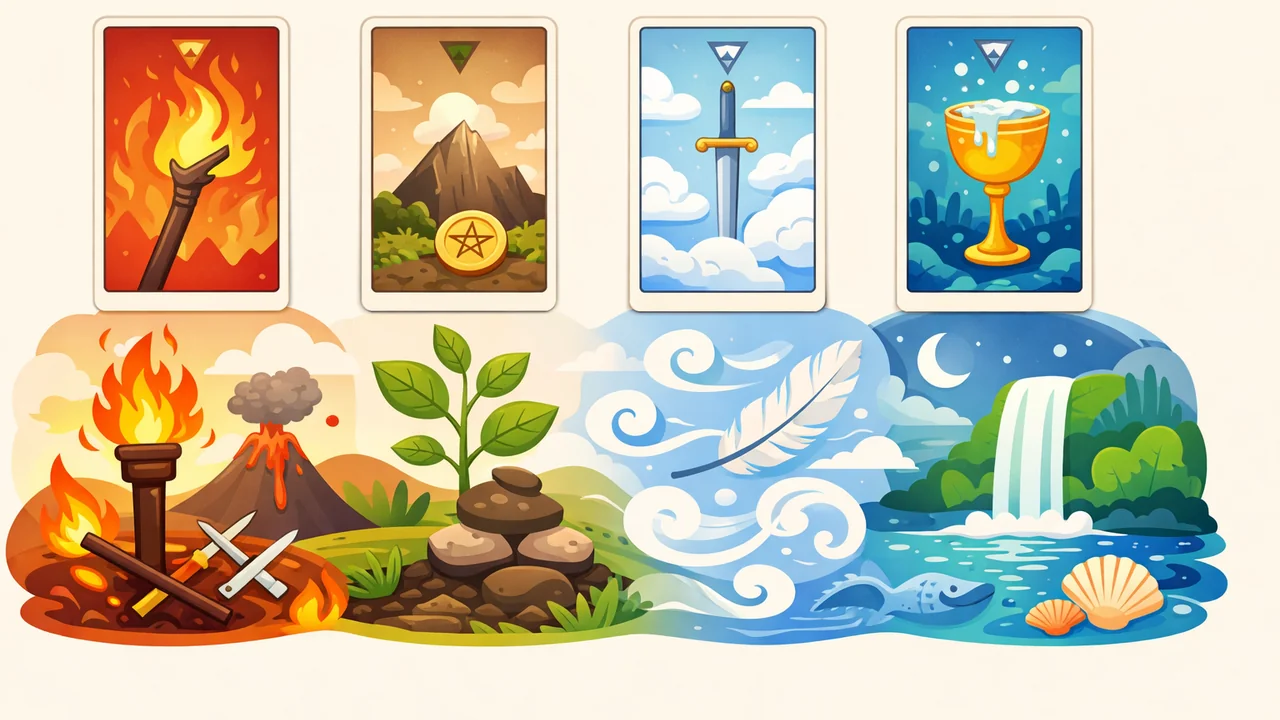
In tarot, the four elements of fire, earth, air and water are more than symbols of nature's basic forces. They are one of the core signals to watch when you interpret a card. Once you know what each element is like, you can read the cards more clearly and make better-grounded calls about love, work and other areas of life.
Below, we start with the basic traits of each element, look at what they generally mean upright and reversed, and then show how to apply them to the two most common topics: love and career. We also cover the mistakes readers often make, a simple element framework for sharper readings, and practical steps you can use right away.
Whether you are new to tarot or already have some experience, understanding how the elements work can help you get past a reading plateau and bring more depth and insight to every spread.
Key takeaway: the four tarot elements (fire, earth, air, water) shape how cards are read. Knowing their symbolism in love, career and daily life, plus a practical framework and the common pitfalls, helps you read with more clarity and depth.
The Basic Traits and Symbolism of the Four Tarot Elements
The four elements in tarot are fire, earth, air and water. They come from ancient philosophy and esoteric tradition and stand for the basic forces of nature. Fire is generally linked to energy, passion and drive; earth to stability, material matters and practicality; air to thought, communication and change; and water to emotion, intuition and the subconscious. When a card carries a clear elemental quality, it helps the reader quickly grasp the heart of its meaning.
Each element shapes not only a card's meaning but also the angle you read it from. Fire cards often point to active effort and creativity, while reversed they may hint at impulsiveness or loss of control. Earth cards upright usually suggest steadiness and harvest; reversed, they can point to stubbornness or stagnation. Getting these basics right is the first step toward deeper interpretation.
Fire: Symbolism and Traits
Fire in tarot stands for passion, drive and creativity. It sparks action and a sense of adventure, and is often tied to inspiration and change. Fire cards such as the Wands suit usually express positive energy and self-expression. Upright, fire encourages you to move forward boldly; reversed, it points to energy out of balance, such as restlessness or excessive impulsiveness.
Earth: Symbolism and Traits
Earth represents stability, practicality and the material world, and corresponds to the Pentacles suit. It speaks of foundations, patience and a down-to-earth attitude. Upright earth cards generally suggest financial security, health and solid ground; reversed, they may hint at stubbornness, stagnation or material difficulties.
Air and Water: Symbolism and Traits
Air (the Swords suit) represents thinking, communication and decisions, standing for reason and change. Upright air encourages clear thinking and honest communication; reversed, it can signal confusion, misunderstanding or indecision. Water (the Cups suit) connects to emotion, intuition and the subconscious. Upright, it suggests emotions flowing in harmony; reversed, it may point to blocked or unsettled feelings.
How to Tell an Element's Core Influence on a Card
To judge how an element shapes a card, look at the imagery, the suit and the card's position. The suit itself tells you the element: Wands are fire, Pentacles are earth, Swords are air and Cups are water. Symbols, colors and movement in the image can strengthen that elemental quality. Finally, whether the card is upright or reversed changes how the element's energy flows and shows up.
Beyond the suit, you also need to look at how elements interact across the spread. When fire and water appear together, it may suggest a clash between feeling and action; earth alongside air may point to tension between reality and ideas. Analyzing these interactions gives you a fuller view of a card's deeper meaning.
- The suit is your first clue to the element
- Image details reinforce the element's qualities
- Upright or reversed changes how the energy flows
- Interaction between elements adds depth to the meaning
Reading the Element from Suit and Imagery
The four suits map directly to the four elements, which makes this the most intuitive method. Wands carry fire's passion and action; Pentacles carry earth's stability and material focus; Swords carry air's thinking and communication; Cups carry water's emotion and intuition. Details like flames, waves, wind or land symbols help you gauge how strong the element's energy is and what state it is in.
Element Interactions and Wider Meaning
The four elements often appear together in a spread, and how they interact shapes the overall reading. Fire against water may suggest a tug-of-war between feeling and reason; earth combined with air may point to a balance between planning and doing. Understanding these dynamics helps you read tension or harmony between cards and gives your reading more layers.
Using the Four Elements in Love Readings
In love readings, the four elements can reveal emotional states, communication patterns and relationship dynamics. Water cards highlight emotional depth and intuitive response, while fire cards reflect passion and drive. Earth cards speak to stability and the practical side of a relationship, and air cards focus on communication and the exchange of ideas. Element analysis helps you gauge how strong, how stable and how potentially troubled a relationship is.
For example, when water cards dominate a spread, the relationship is likely full of emotional ups and downs and sensitivity, so managing feelings may matter. Mostly fire cards suggest a passionate bond that can easily spark conflict. Earth cards point to a solid base that may lack freshness, while air cards prompt you to check whether communication is flowing or whether misunderstanding or distance has crept in.
Water in Love
Water represents the flow and depth of feeling, reflecting sensitivity, empathy and intuition in love. Upright water cards generally show rich, harmonious emotions; reversed, they may suggest blocked feelings, misunderstanding or emotional hurt. When water is strong in a reading, pay attention to inner feelings and how emotions are being shared.
Fire in Love: Passion and Challenge
Fire stands for passion and drive. Upright, it brings energy and creativity to a relationship; reversed, it may show up as impulsiveness, arguments or instability. When many fire cards appear, it is a reminder for both people to balance passion with reason so intensity does not end up hurting each other.
The Four Elements as Signals in Career and Money Readings
In career and finance readings, the four elements offer different angles and signals. Earth cards symbolize financial stability and material foundations: upright, they generally point to healthy, steady finances; reversed, they warn of financial risk or stagnation. Fire cards represent career momentum and innovation, emphasizing action and a willingness to take risks. Air cards focus on strategy, communication and decisions, while water cards remind you of emotional balance and teamwork.
More specifically, when earth cards appear often, your career base is likely solid and suited to steady building. If fire cards dominate, it may be a good time to push into new areas, though you should avoid overreaching. Many air cards call for stronger communication and planning to avoid poor decisions, and water cards remind you to keep good working relationships and emotional balance.
Earth: Steadiness in Career and Finance
Earth cards stand for stability and practicality and are closely tied to financial security. Upright, they suggest sound finances and ample resources, a good setting for long-term planning and saving. Reversed, they may hint at money troubles, draining resources or blocked plans. In career readings, earth emphasizes steady progress over rushing ahead.
Air and Career Decisions
Air represents rational thinking and communication, which are central to career decisions and strategy. Upright air cards encourage clear thinking and effective communication; reversed, they suggest possible misunderstanding, hesitation or missing information. In career readings, the strength of air reflects the quality of decisions and how well communication is working.
Common Mistakes When Reading the Four Elements
Many tarot readers fall into stereotypes or oversimplify the elements, overlooking how they interact and what the card imagery shows. One example is assuming fire always means positive energy and ignoring the warning a reversed card can carry. Another is treating earth as purely about money and missing what it says about health and state of mind. These habits make readings one-sided and less reliable.
Another frequent mistake is ignoring the elemental structure of the whole spread and looking only at a single card's element, which leaves the reading disjointed. Some readers also lean too heavily on element categories and neglect the many layers of symbolism in the card itself, missing the deeper message.
- Oversimplifying element symbolism and ignoring reversed meanings
- Overlooking how elements influence each other across the spread
- Reading single cards in isolation without the whole spread in view
- Relying too much on element categories and missing the card's range of meaning
Mistakes with Fire
Fire is often misread as purely positive energy, when a reversed fire card may point to impulsiveness, anxiety or energy spinning out of control. Missing this can lead you to misjudge the situation.
Mistakes with Earth
Earth covers not only finances but also health, mindset and practical reality. Reducing earth to a money symbol makes it easy to overlook how varied and deep the card's message can be.
In Practice: Using the Four Elements to Read More Clearly
The key to clearer tarot readings is combining element traits with card imagery and spread positions into one overall judgment. First, get familiar with each element's core symbolism and its upright and reversed meanings, and notice how strong each element is and how they interact during a reading. Then adjust your focus to the topic of the question, such as love or career, instead of reading every element the same way.
In practice, you can start by marking the element of each card in the spread, then see which element dominates and whether there is clear tension or harmony between them. Next, combine image details with position meanings to judge how the element energy shapes the overall message. This approach helps you avoid one-sided readings and see the bigger picture.
Step One: Identify the Elements and Image Details
Before reading, confirm each card's element and look at image details such as flames, flowing water, wind or land symbols. This helps you quickly grasp the core energy of the card.
Step Two: Analyze Interactions and the Overall Trend
Look at all the elements in the spread together. Notice whether they are balanced or leaning one way, and judge the direction and strength of their influence on the question.
Step Three: Adjust Your Focus to the Question
Shift your emphasis according to the topic. Love readings usually lean on water and fire, while career readings pay closer attention to the dynamics of earth and air.
The Limits of Element Reading: Factors You Cannot Ignore
The four elements are a valuable tool, but element judgment alone cannot cover every detail of a card's meaning. Each card holds several layers of symbolism, and a reading also needs the spread structure, the context of the question and the reader's intuition. Treat elements as a supporting lens rather than the only basis, or readings can become mechanical and miss the deeper message on the cards.
Element reading can also be challenging for beginners and takes time and familiarity with card meanings to develop. During a reading, keep outside factors in mind too, such as cultural background and the querent's situation, so you do not lean on element categories at the expense of the full context. Understanding these limits lets you use the four elements more flexibly and precisely.
To see what the cards mean in your own situation, bring the question on your mind and draw three cards. It usually feels more real than reading keywords on their own.
Start a Tarot Reading