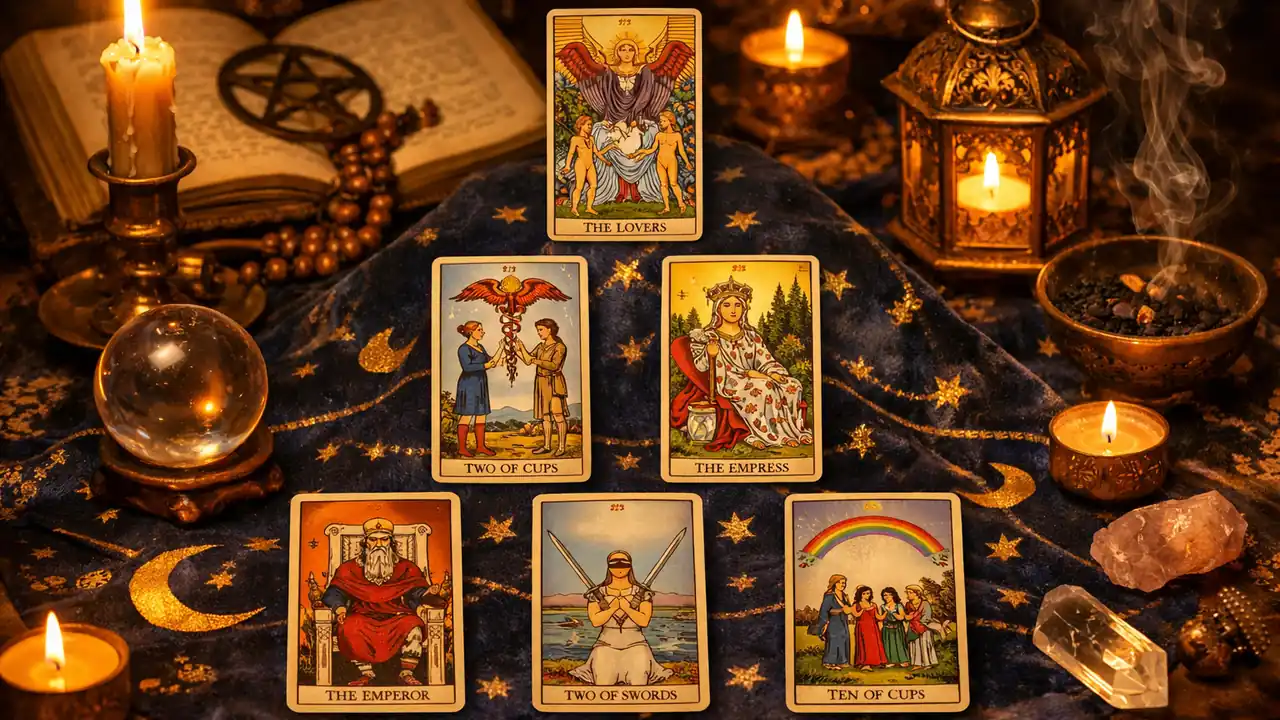
The Lovers Pyramid is a four card love spread: card 1 is you, card 2 is the other person, card 3 is your current relationship, and card 4 is future development. Its strength is simplicity. Each person's state sits on the left and right, the relationship sits in the middle, and the direction sits on top, so you can see at a glance whose side the problem is on and where things are stuck.
Some sources online describe it as a five to seven card spread, but the common Lovers Pyramid is these four cards. There are a few layout variations, but the order and meaning stay the same. Below you will find a layout diagram, questions to ask for each position, a full example reading and the most common ways people misread it.
Key points: 1. Four cards: you, the other person, your relationship, future development. 2. Compare cards 1 and 2 first to see whether the two of you are in sync, then use card 3 to explain why. 3. Card 4 is the trend if things continue as they are, not a final verdict.
How to Lay Out the Lovers Pyramid: Four Positions at a Glance
Shuffle while holding your question in mind, then draw four cards in order. The common layout is three cards in a row below and one card on top, like a small pyramid:
4 Future development
1 You | 3 Your relationship | 2 The other person
Some readers place card 3 at the bottom and card 4 at the top to form a diamond; the meaning does not change. What matters is remembering what each position asks:
Position | Represents | Question to ask yourself
1 You | Your state, feelings and attitude in this relationship | Am I invested, hesitant or worn out right now?
2 The other person | The state and attitude they currently show | What is their pace in this relationship right now?
3 Your relationship | How the two of you currently interact | Are we moving closer, stuck in a standoff, or drifting apart?
4 Future development | Where the relationship may go if it keeps its current direction | If nothing changes, what happens next?
Card 2 reads how the other person presents themselves, not their private thoughts; this is not mind reading. Upright or reversed depends only on the direction the card comes out: image upright means upright, upside down means reversed.
What to Ask, and What Not to Ask
The Lovers Pyramid is built for the space between two people, so it works best for looking at both sides of one relationship and where it is heading:
Situation | Suitable? | Suggestion
In a situationship, wanting to see each other's state and direction | Yes | Use the Lovers Pyramid as is
In a relationship, wanting to understand where things stand | Yes | Use the Lovers Pyramid as is
After a cold war or breakup, wanting to see if either of you has changed | Yes | Read card 4 as the direction if things stay as they are
Relationships involving three or more people, such as a third party | Not really | The spread only holds two people; use one with more positions
Only wanting to know whether to do something | Not really | Use yes or no tarot instead
Torn between two choices | Not really | Use a two options spread instead
You can phrase the question as “What is the state between me and this person right now, and where is it heading?” and add a line or two of background, such as how long you have known each other or what happened recently. The clearer the background, the easier it is to connect the four cards. If you only want to know whether to do something, try yes or no tarot; if you are torn between two choices, try the two options spread.
How to Read It: Compare 1 and 2, Then 3, Then 4
1. Compare cards 1 and 2 first. Are the two of you in sync? For example, if you drew the Knight of Cups (reaching out) and they drew The Hermit (wanting space), your paces are different.
2. Use card 3 to explain why. Where is the relationship stuck: something left unsaid, distance, or one person giving more?
3. Then read card 4. It shows the direction if things continue as they are. Linking it with the first three cards into one sentence means more than reading it alone.
4. Finally, come back to what you can do. Of the four cards, the one you can change most is card 1: your own state and actions.
A Full Example: Two Months of Flirting, Uneven Replies
Say you have been in a situationship for two months, and lately their replies swing between quick and slow, leaving you unsure what you are. You ask: “What is the state between me and this person right now, and where is it heading?” You draw these four cards:
Position | Card drawn | Reading
1 You | Two of Cups (upright) | You like them and want the relationship to be mutual and equal.
2 The other person | Knight of Swords (reversed) | They come across as hurried and scattered: impulsive, speaking too fast, acting on whatever crosses their mind, their pace swinging back and forth.
3 Your relationship | Two of Swords (upright) | The two of you are stuck on something unspoken; neither has said things clearly.
4 Future development | Eight of Wands (upright) | Things may change quickly, with messages and interaction speeding up.
Reading in order: compare cards 1 and 2 first. You want an equal, steady connection, but their pace is scattered right now, so you are out of sync. Card 3 explains why: something between you has not been talked through. Card 4 says that if things continue this way, change will come fast. In one sentence: you want an equal connection, they are a bit scattered, the relationship is stuck on what has not been said, and what comes next will move quickly.
So as a next step, rather than waiting for them to settle down, find a relaxed moment to say clearly what matters to you, for example: “You seem busy lately. When you have time, could we set a time to talk?” The Eight of Wands suggests acceleration; if you make your direction clear first, the speed-up is more likely to go the way you want. For contrast: if card 4 were the Eight of Cups, it would suggest that if things continue this way, someone may turn and walk away first. That too is a reminder to deal with the sticking point in card 3, not a final judgment.
The Four Most Common Misreadings
- Adding a fifth or seventh card without knowing how to read the extra positions. The Lovers Pyramid is four cards; if you want more detail, switch to a spread with more positions.
- Treating card 2 as mind reading. It shows the state the other person displays, and should be read together with how they actually behave.
- Drawing conclusions from card 4 alone. A positive future card does not mean you can do nothing; a difficult one is not a verdict.
- Deciding upright or reversed by a figure's expression or the neighboring cards. Orientation depends only on how the card comes out of the deck.
Want More Detail? Try These Spreads
The Lovers Pyramid is good for a quick, clear look at two people's states. If you want to look at obstacles, advice or outside influences, read how to use a relationship spread, or use the seven card relationship dynamics spread to break down a relationship stuck in push and pull. If you are not sure which spread fits your love question, see which spread to use for love questions. For long-running issues with many sides that need to be laid out from the beginning, consider the ten card Celtic Cross.
No deck at hand, or want to check where the two of you stand first? Write down your situation and use the three cards of the love tarot reading to see where you are stuck, where the relationship may go, and what you can do next.
Start a love reading