The Lenormand Anchor is card 35 of the 36-card deck. It is generally interpreted as stability, security, long-term commitment and putting down roots. Its core message is simple: something has stopped moving, and it is going to stay. The Ship talks about travel and change, and the Rider talks about news that arrives quickly. The Anchor says this situation will be here for a while. So when you ask whether a relationship, a job or a source of income can last, the Anchor usually points toward a stable answer. Stability has two sides, though. It can bring a deep sense of safety, and it can also keep you in the same place long after you wanted to move on. If you are still learning how this deck works as a whole, Lenormand reading is a good place to start.
When you read the Anchor, the most important step is working out whether it means steady or stuck in your question. Staying put can mean you have found a place you want to be. It can also mean you are afraid to leave, or simply cannot. The card does not make that call for you. It depends on what you asked, which cards sit next to it, and how you honestly feel about where things stand. Below you will find the imagery first, then readings for love, work and money. After that come four common combinations, with the Ship, the Cross, the Fish and the Tree, and finally how the Anchor differs from the tarot suit of Pentacles. The aim is that the next time the Anchor lands in your spread, you can read it in a way that fits your real situation, not just a one-line keyword.
How to Read the Anchor Card Image
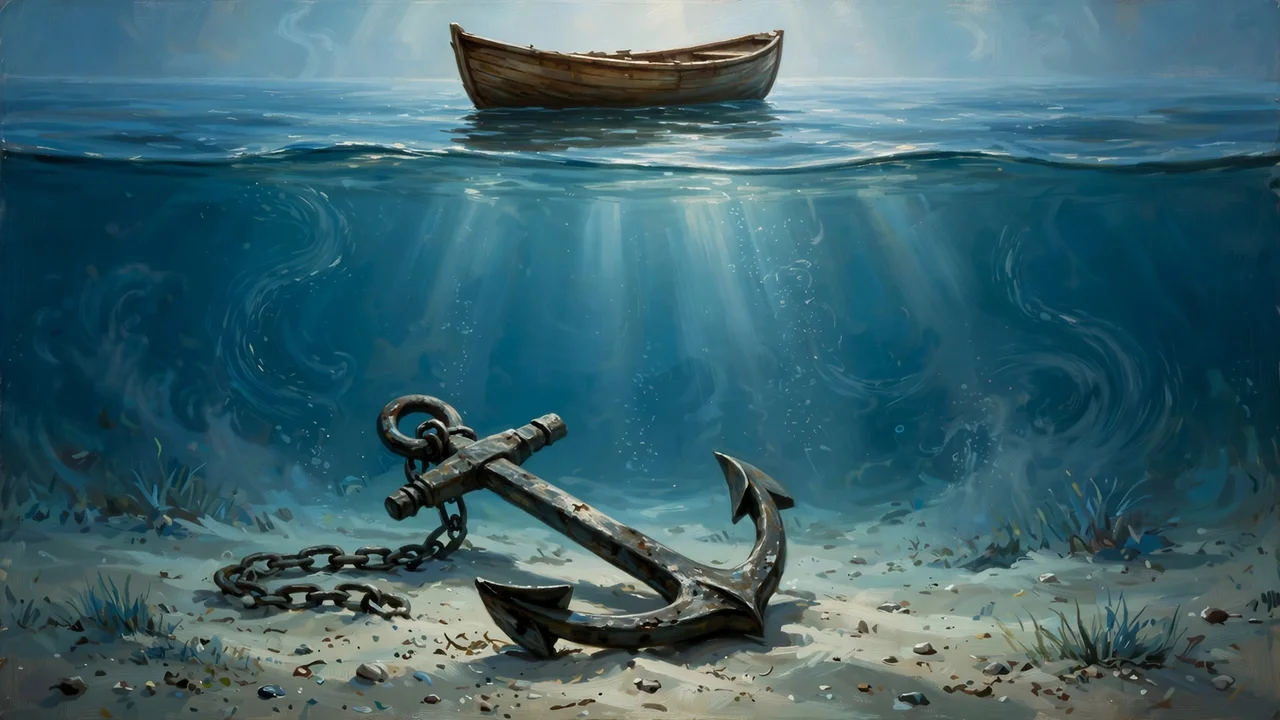
The Anchor card usually shows an iron anchor resting on the sea floor or leaning against the shore. Water and sand surround it, and sometimes you can see the horizon in the distance. The message of the picture is direct: boats drift and waves crash, but once the anchor is down, whatever it holds stays where it is. The tide does not carry it away.
Start with the anchor itself. It is heavy metal, and its job is to hold something in place, not to push it forward. That is why the Anchor is generally interpreted as a sign that the people, plans or circumstances in your question will tend to stay and settle rather than change or move. Then look at the water. The sea stands for ups and downs in the outside world, such as moods, surroundings or shifting markets. The anchor sits beneath all of that. Even when the surface is rough, something below still holds firm.
The beach and the shoreline add the idea of arrival. You only drop anchor once you have sailed somewhere and decided not to go further. This is why the card is often read as finally settling down: after a period of drifting or searching, the matter has found somewhere to land.
A simple image helps here: a boat sits in harbour with its anchor lowered. Ask yourself whether this boat has stopped to rest, restock and stay a long time, or whether it wants to leave but cannot pull the anchor up. The same picture can feel completely different, and that is where the card's double nature begins. For the card's basic details, see the Anchor card meaning.
Core Meaning of the Lenormand Anchor
A common view is that the Anchor has five keywords: stability, security, long-term commitment, roots and endurance. All five point to the same idea. Things are going to stay, and they will build up slowly over time.
Stability means the situation is unlikely to swing wildly. If the matter you are asking about is going through a rough patch, the Anchor is often read as a sign that things will gradually calm down. Security works on an inner level. It describes the feeling that you have something solid to lean on, whether in a relationship, a job or the way you live.
Long-term commitment is the meaning that comes up most in questions about love and partnerships. The Ring speaks more directly about contracts and agreements. The Anchor puts the weight on wanting to stay. Roots have more to do with lifestyle and place, such as settling in a city or working steadily in one field for years. Endurance is about time. What the Anchor describes is usually not brief. It tends to continue for a good while.
Remember that staying is not the same as good. What stays could be something you love, or something you would rather be rid of. For example, if you ask whether a worry will pass, the Anchor may suggest that it will linger for some time and needs a longer, steadier approach. So when you read this card, first check which way your question points. Then decide whether staying is good news for you or something to prepare for early.
Steady or Stuck?
The most interesting thing about the Anchor is that it cuts both ways. The same anchor that keeps a boat from being blown away in a storm can also keep it from leaving when it is time to sail. Lenormand does not read cards by the way they face, so whether the Anchor means steady or stuck depends on the question itself and the cards around it.
Readings that lean toward steady usually have a few things in common. You already hoped things would settle, the surrounding cards are supportive or positive, and you feel more at ease than anxious about where things are. In that case the Anchor works like a quiet confirmation: the place you are in is somewhere you can stay and slowly build.
Readings that lean toward stuck tend to show up in other moments: when you are asking whether to make a change, when nearby cards suggest obstacles or burdens, or when part of you has felt restless for a long time. Here the Anchor points to stagnation rather than safety. Things are standing still, and standing still for too long has its own cost.
One practical way to tell the difference is to set a clear question before you draw. Instead of asking how this job is going, ask what the next six months will look like if you stay in it. A clear question helps the Anchor settle on one side or the other. For more on phrasing, see how to ask Lenormand questions. If you want to compare the Anchor with other stability cards, Lenormand relationship stability covers that more fully. Here the focus stays on the Anchor itself.
The Anchor in Love
In love questions, the Anchor is generally read as long-term commitment and emotional security. If you are asking about an established relationship, it usually points to a reliable foundation: two people who want to stay by each other's side, in a bond that small disagreements are unlikely to wash away. For a relationship that has only just begun, the Anchor may hint that this connection could last rather than being a brief spark.
If you are single and draw the Anchor, a common reading is that you may be looking for someone who makes you feel safe, or that the next person you meet could bring a more grounded feeling. This does not mean someone will appear right away. It suggests that what you want from love is shifting from novelty and excitement toward steadiness and reliability.
The Anchor has another side in love, too. Stability is good, but if neither person is moving forward and you are together mostly out of habit, the card may be pointing to stagnation. Think of couples who have been together for years but never talk about the future, whose time together has become routine, or where one partner keeps their feelings to themselves for fear of rocking the boat. In those moments the anchor is not protecting the relationship. It is pinning it in place.
Two questions can help. Does this relationship make me feel safe, or afraid to move? Are we resting in the harbour together, or does one of us want to sail while the other holds the anchor? The card does not decide whether you should stay. It shows you what staying looks like so you can see it clearly. Where a relationship goes still depends on the choices and communication of both people, and no card has the final word.
The Anchor in Work and Career
In work questions, a common view is that the Anchor stands for a stable position, a long-term working relationship and a foundation you can rely on. If you are job hunting, it may suggest that the next opportunity will be something lasting rather than a short project or a temporary role. If you already have a job, the Anchor usually says that your position is steady for now and unlikely to change much in the near future.
The Anchor is also linked to putting down roots in a field. Some people ask whether they should keep building their skills in one profession. In that context the card is often read as a sign that steady effort pays off over time, as experience and trust build into a solid base for later.
The other side is being stuck. A stable job is not always the right job. If you are asking about a promotion, a career change or a new direction, the Anchor may be saying that the current situation will continue for a while. The promotion is not coming yet, the change is not happening yet, or you are not ready to let go. This is a good moment to ask what is actually keeping you there. Is it real enjoyment, fear of change, or practical realities such as bills and responsibilities?
If it is one of the last two, the Anchor is not telling you to grit your teeth and put up with it. It is asking you to look clearly at your reasons for staying. Sometimes staying is a sensible choice, for example while you save money or gain experience. Other times it is worth quietly preparing for change, even if you cannot leave yet. The card describes the current trend, not a fixed outcome, and your career path is still yours to choose.
The Anchor and Money
In money matters, the Anchor still asks whether something can be held on to. In financial questions it is generally interpreted as steady income, predictable expenses and savings that grow little by little. This is not a card of sudden windfalls or overnight wealth. It is a card of slow, steady flow: money may not arrive quickly, but once it does, it is less likely to slip away.
When it comes to mindset and habits, the Anchor encourages you to build a foundation. A regular savings habit, clear records of what comes in and goes out, and an emergency fund are all ways of dropping anchor with your money. When you draw this card, it is a good moment to check whether your finances have a stable base, and whether you could absorb an unexpected expense.
The Anchor also has a stuck side in money matters. Your income may be steady but has not grown for a long time. Your expenses may be fixed, yet some of them should have been reviewed long ago. Or fear of risk may stop you from making even the changes you know are needed. These all belong to the Anchor's stagnant side: the money is not draining away, but it is not moving either.
To be clear, tarot and Lenormand can only speak to your state of mind and approach to money. They cannot tell you where to put it. Investing carries risk, so please consult a qualified professional for specific decisions. The cards are better suited to questions about yourself, such as which of my money habits needs adjusting right now, than to picking an investment. Treating the Anchor as a reminder to steady your foundation is far more useful than treating it as an investment signal.
Anchor Combinations with Nearby Cards
Lenormand reading puts a lot of weight on how cards combine, and the Anchor is no exception. Here are four common pairings. Always bring them back to the question you actually asked.
Anchor + Ship: the Ship represents movement, distance and journeys, which looks like the opposite of the Anchor's staying power. Together, they are often read as stability that comes from far away. This could be long-term income from another city or country, an extended stay somewhere because of a work posting, or a relationship that began at a distance and later settled down. You can read it alongside the Ship card meaning.
Anchor + Cross: the Cross stands for burden, trial and responsibility. Paired with the Anchor, it is commonly read as a long-lasting burden or a test that has to be endured. It is not purely bad news. It may also describe a responsibility you are carrying that will continue for some time and calls for patience and the support of people around you.
Anchor + Fish: the Fish relates to money, flow and business. With the Anchor, it is generally interpreted as a steady flow of money, such as a regular source of income or a business built over the long term. The key idea is flowing but stable: money moves in and out, and the rhythm is predictable. For more, see the Fish card meaning.
Anchor + Tree: the Tree relates to health, growth and the roots of life. Combined with the Anchor, it is often read as long-term health and a settled way of life, such as regular routines or living steadily in one place. If you feel unwell, please see a doctor. The cards only describe a state and do not replace medical judgment. To learn more, see the Tree card meaning.
Anchor vs the Tarot Pentacles
Many people who study both tarot and Lenormand link the Anchor with the tarot suit of Pentacles, because both feel grounded, material and stable. They focus on quite different things, though.
The Pentacles suit in tarot is about value and the material world. It looks at what you own, what you invest and what you create. That covers everything from craft and work skills to how resources are shared, physical wellbeing and quality of life. The Pentacles cards cover different stages and situations, and each one describes part of your relationship with the material side of life.
The Lenormand Anchor is simpler. It asks whether something can be held on to. Whether it is money, a person, a job or a home, the Anchor asks: once this arrives, will it leave? Will it stay here? So the Anchor does not really judge how valuable something is. It speaks to how lasting and stable it is.
For example, if you ask about a particular income, a Pentacles card might describe the sense of worth behind it and whether your effort is being rewarded. The Anchor would describe whether that income is steady and whether it will continue. The two perspectives can complement each other, but try not to mix them. When you read Lenormand, think in Lenormand terms and read the Anchor as staying and continuing. Its meaning will become much clearer. If you are still finding your way with this deck, is Lenormand accurate sets out its strengths and limits and can help you keep your expectations realistic.
What to Ask After Drawing the Anchor
Once the Anchor appears, it helps more to follow up with further questions than to rush to label it good or bad. Here are a few useful directions.
First, ask what is staying. The Anchor says something will remain, but that something could be a relationship, an income, a responsibility or a feeling. Naming it tells you whether this stability is something you want or something you need to deal with.
Second, ask how you feel about where things stand. The same Anchor reassures someone who feels safe and nudges someone who feels stifled. The card cannot feel for you, and your own feelings are part of the reading.
Third, look at the surrounding cards. The Anchor rarely decides its meaning alone. If supportive or positive cards appear beside it, the steady reading becomes clearer. If cards of burden or obstruction show up, pay closer attention to the chance that you are stuck. Reading three cards together gives you much more context than reading the Anchor on its own.
Fourth, ask what you can do next. The Anchor describes a trend, not a conclusion. If it means steady, think about how to look after that stability. If it means stuck, think about which small steps could help you loosen things bit by bit. The Bear also carries a sense of stability and protection and is often compared with the Anchor. See Lenormand Bear meaning to explore how the two differ in strength and staying power.
References
Bring your question about whether to stay or move on to a Lenormand reading, and see how the cards describe where you stand right now.
Try a Lenormand reading