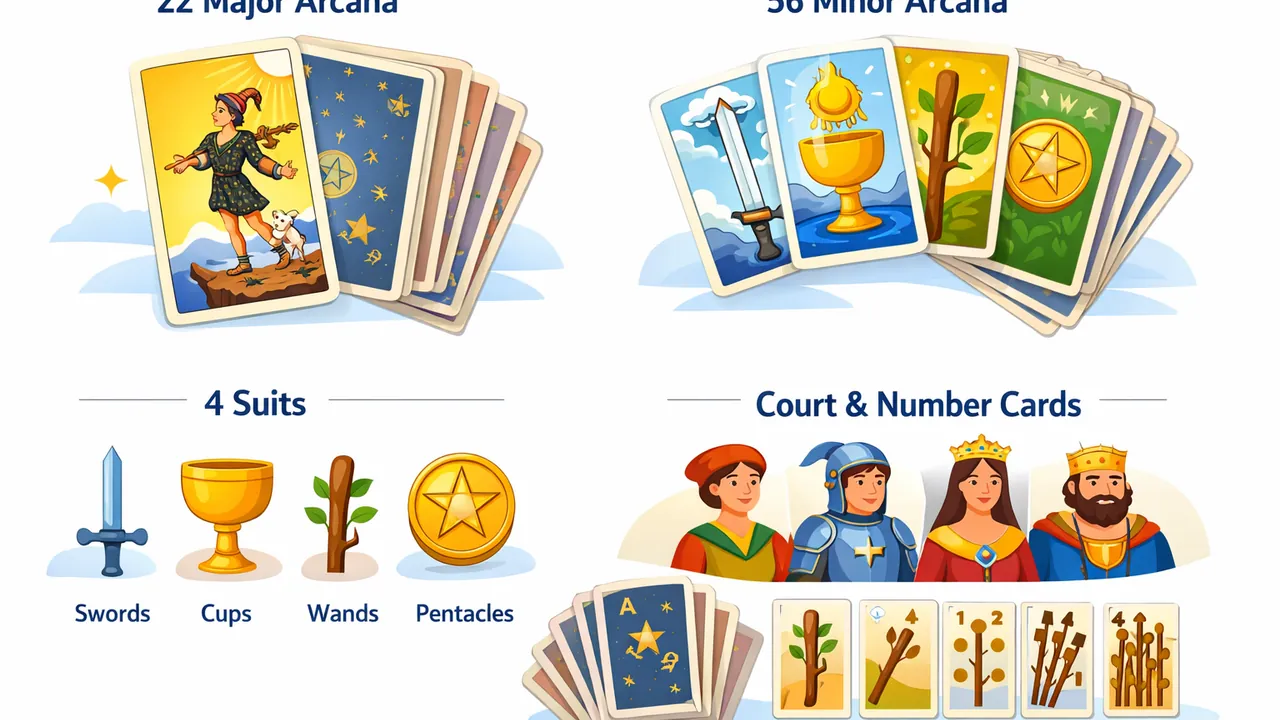
How do you understand tarot card meanings? Start with the overall structure and categories of the 78-card deck. That is the foundation for grasping what each card is really saying. Once you see how the Major and Minor Arcana work, what they symbolize and how they relate to one another, you can stop memorizing keyword lists and give clearer, more grounded readings.
The guide below starts with the basic architecture of the deck, then breaks down the Major and Minor Arcana step by step and shows how to read cards in love and career questions. It also covers common misconceptions and misreadings, along with concrete methods you can use in your own readings.
If you're new to tarot or want to deepen your understanding of card meanings, use this as a reference that takes you from the basics to more advanced reading and gives you a complete framework for interpreting any card.
Key takeaway: understanding tarot card meanings starts with the structure of the 78-card deck. Learn the core themes of the Major and Minor Arcana, apply a practical interpretation framework and steer clear of common mistakes to grasp each card's deeper meaning and how to use it.
The 78-Card Tarot Structure: Major Arcana and Minor Arcana
A tarot deck has 78 cards divided into two parts: 22 Major Arcana cards and 56 Minor Arcana cards. The Major Arcana represent life's big lessons, inner growth and turning points, and are generally read as the forces of the spirit and the deeper mind. Each card carries its own symbols and story. The Fool, the Magician and Death, for example, point to key stages and challenges along life's journey.
The Minor Arcana are split into four suits: Wands (action and creativity), Cups (emotions and relationships), Swords (thoughts and conflict) and Pentacles (material and practical matters). Each suit has 10 number cards and 4 court cards (King, Queen, Knight and Page), which reflect concrete situations and roles in everyday life. These categories are the foundation of the whole deck. They help you quickly place a card's range and depth of meaning.
The Symbolism of the Major Arcana
The 22 Major Arcana run from card 0, the Fool, which stands for new beginnings and potential, to card 21, the World, which represents wholeness and completion. Together they trace the soul's growth through awakening, challenge, transformation and realization. Each card is rich in symbols: the lion in Strength is generally read as courage, and the Hermit's lantern as introspection.
The Four Suits and the Court Cards
Each suit has its own theme and energy. Wands relate to creativity and drive, which makes them useful for career and plans. Cups are closely tied to feelings and relationships and come up often in love readings. Swords speak to thought, decisions and conflict, a reminder to watch logic and tension. Pentacles concern money, security and practical life, reflecting finances and daily circumstances. The court cards portray different personalities and roles, which helps make a reading more specific.
A Core Framework for Reading Any Card Quickly
The fastest way to learn tarot card meanings is to build a framework for judgment rather than memorize vocabulary. First, look at the card's category and symbolism: its suit, its number and its position tell you what kind of energy and theme it carries. Next, study the imagery and colors on the card to read the mood and message. Finally, place the meaning inside the actual question and adjust your angle to fit the type of question.
Take the Three of Wands, which is generally associated with planning and looking ahead. In a career spread, it can point to future growth and opportunities to collaborate. In a love spread, it may suggest a new stage in the relationship or a shared goal. Combining category, symbolism and context like this lets you read each card more flexibly and more precisely.
Use Suit and Number to Find the Theme
The suit sets the general direction: Wands lean toward action, Cups toward emotion. The number shows the stage and intensity, from the starting energy of the Ace to the completion and transition of the Ten. Knowing what numbers symbolize, such as three for growth and cooperation or seven for challenge and reflection, helps you find the core of a card fast.
Read the Mood Through Imagery and Color
Tarot images are full of symbols. Details like a figure's expression, posture and background all offer clues. Colors carry psychological cues too: red often suggests passion or crisis, blue calm and introspection. Looking closely at these elements helps you catch the emotional layer of a card instead of stopping at a surface reading.
Common Mistakes and Myths About Tarot Card Meanings
Many people learning tarot fall into the trap of memorizing keywords and overlook the symbolism and context behind each card. That makes readings rigid and hard to adapt to different questions. Another common misunderstanding is that reversed cards are always negative. Reversals can mean many things, such as a blockage, inner reflection or a shift in energy, and they need to be read in light of the whole spread.
Another myth is that tarot directly predicts the future. Tarot is better understood as a way to reveal present energies and possible trends so you can make wiser choices. It doesn't give absolute answers; it is a tool for guidance and reflection.
- Memorizing keywords ignores symbolism and context
- Reversed does not mean negative; read it with the spread
- Tarot is not a prediction tool but a prompt for reflection
In Practice: Better Questions and Spreads for Clearer Readings
How you ask shapes what a reading can tell you. A good question is specific and open, not vague or loaded with the answer you hope for. 'Will I succeed?' is too broad. 'What is the main obstacle in my career right now?' lets the cards reflect your current situation and point toward advice much more clearly.
Choosing the right spread matters too. Different layouts focus on different angles: a three-card spread gives a quick look at past, present and future, while a cross spread examines a problem in layers. Learning to match the spread to the question, then reading each card together with its position, makes your interpretation deeper and clearer.
How to Ask an Effective Tarot Question
An effective question is specific and neutral, without leading wording. Focus on the current situation, obstacles, resources or advice so the cards can speak to your circumstances. For example, 'How can I improve communication with my partner?' invites a more constructive reading than 'Are we going to break up?'
Choosing the Right Spread
Pick a spread based on how complex your question is and how many angles it has. Simple questions suit a three-card spread, which gets to the core quickly. Complex ones suit a cross or the Celtic Cross, which unpacks the factors layer by layer. Knowing the structure of a spread and what each position means is what lets you read the cards and the relationships between them.
The Limits of Tarot Card Meanings: When They Don't Apply
Tarot reading is not all-powerful and has clear limits. First, tarot can't give exact dates or absolute answers, and leaning too heavily on that kind of reading can mislead you. Second, a card's meaning is shaped by the querent's state of mind and the spread chosen. A vague or biased question weakens the reading considerably.
Tarot also isn't suited to medical, legal or similar professional decisions; those call for qualified professionals. And tarot reading has to respect free will. It can't force or replace a person's own decisions, or it loses its purpose as a tool for guidance.
- It cannot give exact timing or absolute answers
- Unclear or biased questions weaken the reading
- It is not a substitute for medical or legal advice
- Respect free will; don't let it decide for you
Reading Card Meanings for Love and Career Questions
In love readings, the focus is usually on emotional states, how two people interact and where things may be heading. Among the Major Arcana, the Lovers is generally read as choice and the depth of a bond, while the Cups suit reflects how feelings are actually exchanged. Read the cards against both people's situations and the background of the question, avoid drawing conclusions from one card and notice when a reversal may point to inner conflict or a communication block.
Career readings lean more on the energy of Wands and Pentacles. Wands represent ideas, plans and drive, while Pentacles focus on money and resources. Look at how each card relates to its position in the spread: the Seven of Wands reversed may suggest competitive pressure or low confidence, while the Ten of Pentacles upright points to a stable material base.
Key Points for Love Readings
In love readings, focus on the flow of feelings and how the two people interact. Cups reveal emotional depth and the quality of the relationship, while Major Arcana cards like the Lovers and Strength reflect its challenges and growth. Reversals may hint at misunderstanding, obstacles or inner struggle; read them with the whole spread in mind.
Tips for Career Readings
Career readings center on drive and managing resources. Wands symbolize planning and execution, Pentacles finances and practical reality. Pay attention to upright and reversed positions, the stage shown by the number and the roles of court cards to help understand the current situation and possible directions ahead.
Want to see what the cards mean in your own situation? Bring the question you have right now and draw three cards. It usually feels far more meaningful than reading keywords alone.
Start a Tarot Reading