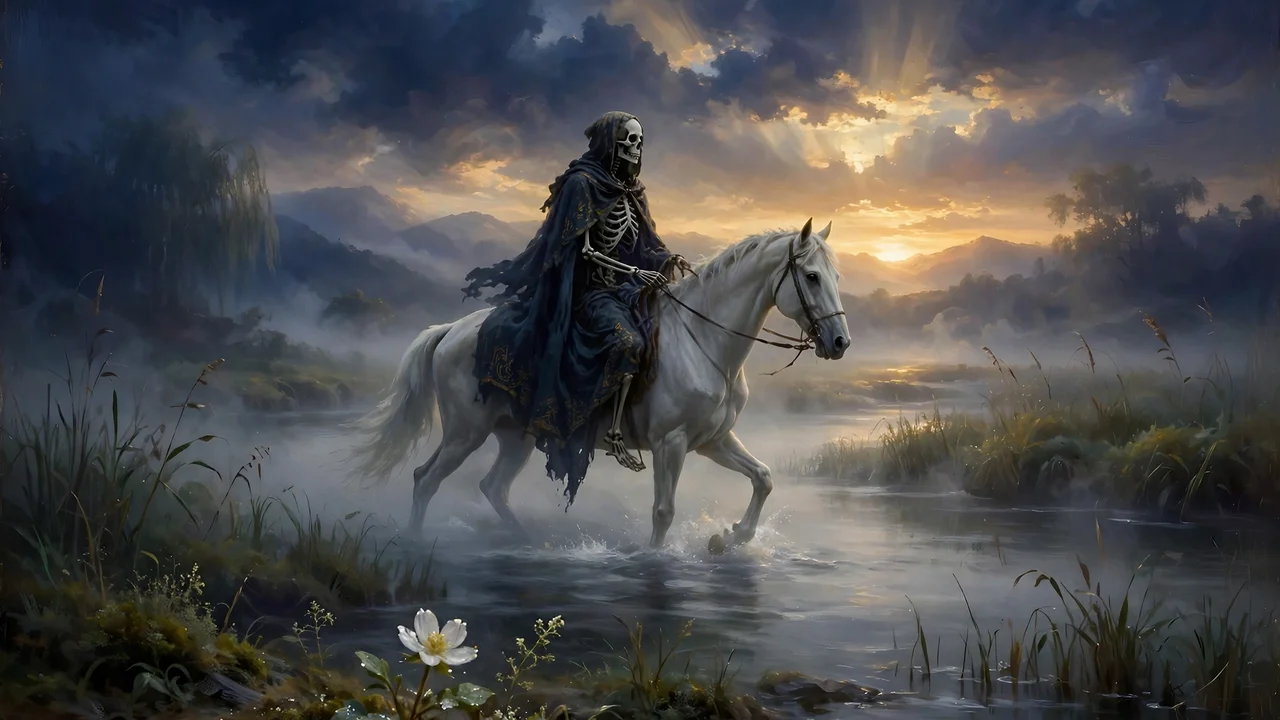
The moment the Death card turns up, most people feel a jolt, and a flood of thoughts follows: Is something bad about to happen? Should I reshuffle right now? Here is the short answer. Drawing the Death card does not mean someone is going to suffer a misfortune, and it is not a verdict on how your story ends. It is generally interpreted as a sign that a chapter is closing, and when one chapter closes, room usually opens up for something new. The card itself is not the problem you need to solve. What matters is what you do after the scare. Treat the card as an invitation to look honestly at what is changing, not as a warning to brace against, and the whole reading becomes far easier to work with. Once the fear settles, many people find the card points to something they already sensed was ending. If you have not actually drawn any cards yet and want to try with your own question first, you can start with a tarot reading.
This guide does not repeat the full meaning of the Death card; that is covered separately. Instead, it focuses on what actually helps in the moment you draw it: how to calm yourself down first, how to read the role the card plays in your spread, and how to turn a spiraling question like “Is something bad going to happen?” into a follow-up question that gives you direction. You will also learn when it is reasonable to draw again and when reshuffling only makes the answers more confusing. Finally, it walks through practical next steps for three common situations: love, work and money. You do not need to memorize any card meanings. Keep a notebook or notes app nearby, because writing things down is part of the process. Then work through the steps one at a time, and a moment of fright can become a chance to get clearer about your own life and what you are ready to change.
Why the Death Card Feels So Scary
The name alone carries a heavy emotional charge. In everyday life we rarely talk openly about endings and loss, so when the word Death appears on a card, the brain instinctively links it to the worst possible outcome. The imagery is usually somber and dark as well, so a racing heart or sweaty palms the first time you see it are completely normal reactions. They do not mean you are fragile, and they do not mean you did something wrong.
Still, tarot names and pictures are a symbolic language, not a literal forecast. A common view is that the Death card is about the turning of a cycle: one state of affairs reaches its end so that the next one has a chance to begin. Think of the seasons. When leaves fall in autumn, the tree is not dying; it is clearing space for the next round of growth. So when this card shows up, instead of asking “Who is going to get hurt?”, first admit that the name startled you, then remind yourself that this is a symbol about change.
One more thing worth remembering: the Death card appearing in a spread does not mean anyone around you is in danger, and it is not predicting an accident or a health crisis. Tarot speaks to moods, choices and the direction of a situation. It cannot, and should not, be used to predict specific misfortunes. For a fuller look at its symbolism, read the complete Death card meaning. Here, the focus stays on what to do right now.
Your Fear Is Also a Message
Many people rush to push their fear down, as if the card would somehow become kinder once they stopped being afraid. In fact, the fear deserves attention, because it usually points straight at the thing you care about most and least want to lose. When you draw the Death card, notice the first person or situation that comes to mind. That thought is the real heart of this reading.
Try asking yourself a few questions. Am I afraid of the ending itself, or of the unknown that comes after it? Have I been quietly sensing that something cannot go on like this, without feeling ready to face it? If this situation really did come to a close, what would I miss most? You do not need answers right away. Simply thinking them through once often reveals that the card has not touched some unfamiliar disaster, but something you already knew about and kept putting off.
This is also why two people can draw the same Death card and react in opposite ways: one feels relief, the other cannot sleep. The difference is not in the card but in each person's circumstances. When you treat fear as a clue rather than a sentence, you get far more useful information from the draw than a simple “good” or “bad”.
Be careful, though: noticing your emotions is not the same as blaming yourself. You did not draw this card because you were in a bad mood or overthinking. The card simply reflects a theme you are already turning over. Being gentle with yourself makes it easier to see what it is pointing toward.
Step One: Pause and Breathe
The first step sounds the easiest, yet it is the one people skip most often. The instant the Death card appears, it is tempting to flip the next card, search online, or reshuffle immediately, trying to bury the unease under more information. But readings made in a panic tend to be steered by fear, and the more you look, the darker everything seems.
Instead, leave the card where it is. Do not rush to turn over the others or reach a conclusion. Spend a minute or two breathing slowly: count to four as you breathe in, pause briefly, then count to six as you breathe out, so the exhale is a little longer than the inhale. Afterward, check in with your body. Are your shoulders hunched? Is your jaw clenched? Let that tension go, then return to the card.
This pause is not a ritual or a way of cancelling anything out. It simply brings your judgment back online. Reading tarot calls for a clear head, not a startled reflex. Once you shift from “This is terrifying” to “Let me see what it is trying to say,” the same card can feel completely different.
If you still feel shaken after breathing, it is fine to set the reading aside. Get a glass of water, take a short walk, and come back later. The card is not going anywhere, and you do not need to force yourself to understand everything at the peak of your emotions. Giving yourself a buffer respects your question and takes care of you. Often, a card that felt harsh at first reads like a calm reminder when you return to it.
Step Two: Check Its Position in the Spread
Once you feel steadier, the second step is to look at where the Death card landed. The same card can mean very different things in different positions, so the name alone is not enough to draw a conclusion.
Take the common three-card past, present and future spread. In the past position, Death is generally interpreted as a transformation that has already happened, such as a relationship or life phase that has ended, with you now living with its effects. In the present position, a common reading is that you are in the middle of a transition: the old is loosening and the new has not yet taken shape, which is exactly why you feel uneasy. In the future position, it works more like a directional hint: things may be heading toward some kind of closure, and that closure could free you from feeling stuck.
If you are using a situation, obstacle and advice spread, Death in the advice position often means “It is time to let go,” not “Something bad is coming.” In the obstacle position, it may suggest you are resisting a necessary change, and that resistance is what keeps things stuck.
Also look at the cards around it. Neighboring cards add detail about the nature of this ending: a gentle transition or a decisive cut, a change in your outer circumstances or a shift in your inner thinking. Reading the spread as a whole is far more useful than staring at the Death card and worrying about it. To compare its basic symbolism, see the Death card meaning.
Step Three: Write Your Question Down
The third step is to go back and examine your question. Often the Death card feels frightening not because the card is harsh, but because the question was too vague or too extreme. Questions like “What will happen between us?” or “Is my job okay?” are so broad that any card could be read in many directions, and when Death shows up, the mind naturally jumps to the worst one.
Grab a piece of paper or open a note on your phone, and write the question exactly as it was in your head. Then check three things. First, does it ask whether something will happen, or what you can do? Second, is the time frame clear? Third, is the main character you, or someone else whose choices you cannot control?
Once it is written down, you will often spot hidden assumptions. “Are they going to leave me?” assumes that the direction of the relationship is entirely in the other person's hands. When you see that clearly, the Death card is no longer a verdict that your partner is leaving. It may instead be a reminder that the way you have been keeping the relationship going needs to change.
A clearly written question also makes it easier to look back later. Open the note a few weeks from now and see how the things you worried about actually unfolded. You will learn a lot about how you think under pressure. If you often struggle to phrase questions, how to ask tarot questions has more ways to sharpen them.
Reframe “Will Something Bad Happen?”
After the three steps, you can start asking follow-up questions. The key is to replace yes-or-no questions that feed fear, like “Will something bad happen?”, with open questions that lead to action. The Death card is about endings and transitions, so follow that theme.
Here are some phrasings you can use as they are:
“What change will this ending bring me?” This shifts the focus from loss to change and helps you see the space that may open up afterward.
“What do I need to let go of in this situation?” This helps you identify what needs to end, whether that is a habit, an expectation or a pattern of interaction that keeps repeating.
“What do I need to prepare for a new beginning?” This moves your attention to the next step, so the card becomes a starting point as well as a full stop.
“What change am I resisting most right now, and what has that resistance cost me?” This works well when you feel stuck, knowing you should change but not moving.
“If I choose to end this situation myself, what should I watch out for most?” This suits anyone already weighing a decision and wanting to check for overlooked details.
When you follow up, ask only one question at a time. After drawing, write down your first impression, then interpret it in light of the card's position. Avoid firing off five or six questions in a row, and do not switch questions just because you dislike an answer. Good follow-up feels like a conversation with yourself, peeling back one layer at a time, not a hunt through the deck for a card that makes you feel safe.
When Is It Okay to Draw Again?
After drawing the Death card, the most common urge is to reshuffle. Drawing again is not always wrong, but it helps to tell the situations apart.
There are a few cases where a redraw makes sense. Something genuinely went wrong during the draw, for example a card fell out of the deck or your shuffle was interrupted and you are not sure which card was meant. Or you realized afterward that the original question was flawed, perhaps mixing two separate issues into one. In that case, rewrite the question clearly first, then draw for the new question. It is also fine to ask again once some time has passed and the situation has actually changed.
The case where you should not redraw is when nothing has changed, neither the question nor the situation, and you simply do not like the card. The trouble is that you start keeping score in secret: you believe the good cards and throw out the ones you dislike. What you end up with is not an answer but a pile of contradictory cards, more confusion and more anxiety.
If you have asked the same question several times and Death, or cards with a similar theme, keeps appearing, treat it as a theme worth taking seriously rather than a curse. See when the same card keeps appearing for more. For how often it makes sense to ask, how often you can read tarot goes into detail. In short, changing the question usually helps more than changing the card, because what shifts is your perspective, not just the cards on the table.
Drawing the Death Card in Love
When the Death card appears in a love reading, the biggest worry is usually “Are we breaking up?” In relationships, it is generally interpreted as the end or transformation of a relationship's form, not necessarily the end of the relationship itself. Moving from a situationship to something defined, from the honeymoon phase into steady partnership, or from long distance to living together are all endings of an old form.
When you draw it, try this next step. Think about which patterns between you no longer fit where you are now: perhaps the same person always gives in, a certain topic is always avoided, or conflict is handled with the silent treatment. If those patterns end, the relationship may actually become healthier. Then follow up with questions such as “What do we need to let go of together in this relationship?” or “What do I hope this relationship can turn into?”
If you are single, the Death card may point to an old belief about love that is starting to loosen, such as a fixed picture of the ideal partner or unresolved feelings left by a past relationship. You might ask: “Which part of my past am I ready to release so that new connections have room to appear?”
Whatever your situation, how things unfold still depends on communication and on the choices both of you make. The cards can help you see a direction, but they will not decide the ending for you. Rather than searching the cards for a yes or no on breaking up, take the reminder they offer and find a time to have an honest conversation with your partner.
Drawing the Death Card About Work
When the Death card shows up in a work question, many people's first thought is “Am I going to be laid off?” A common view is that, in a career context, Death more often points to the wrap-up of a project or role: a long-running project is about to close, a phase of work is finishing, your responsibilities are changing, or your own enthusiasm for the job and your sense of place in it are shifting.
Here is a practical next step. Take stock of what you are working on right now. Which tasks are nearly done, and which should have ended long ago but keep dragging on? Finish what needs finishing properly, and document your results and lessons. That will help whether your next move is an internal shift or a change of path entirely. Then follow up with questions such as “Once this phase ends, which skills do I most want to develop?” or “Which way of working do I need to let go of in my current job?”
If you were already thinking about changing jobs, treat the Death card as a prompt to examine your reasons honestly. Are you trying to escape something, or move toward something? Those two call for very different kinds of preparation. For more on reading this card during a career change, see the Death card and career transitions.
Remember that tarot can help you organize your thoughts, but it cannot replace real career planning or professional advice about employment rights. Concrete decisions should rest on your actual circumstances, your finances and what you genuinely want.
Drawing the Death Card About Money
Drawing the Death card in a money question does not have to mean bankruptcy or loss. In financial situations, it is generally interpreted as the end of a spending habit or a sign that your approach to money is due for an update. Impulse buying, spending to keep up appearances, or subscriptions you pay for but rarely use could all be the kind of thing the card is nudging you to end.
Try this next step. Spend a little time reviewing the past month or two of spending. List where the money went, and circle the items that did not leave you happier or more secure afterward. Those are the areas you might consider bringing to a close. Then follow up with questions such as “What money habit do I most need to change right now?” or “Once I end this spending pattern, what do I want to put those resources toward?”
The Death card may also appear during a time when your sources of income are changing, for example when a side job ends or an income stream becomes less reliable. Rather than worrying, prepare early: review your budget, build a small cushion of savings, and think about which of your skills could be turned into income. The more concrete your preparation, the less your emotions will push you around when the change arrives.
To be clear, tarot is not a substitute for investment judgment, and it should not be used to decide whether to buy or sell any asset. The cards can help you see your relationship with money, but concrete financial decisions should be based on real numbers and professional advice.
References
Bring the question that truly matters to you to a tarot reading and see what the change in front of you may be reminding you of.
Get a Tarot Reading