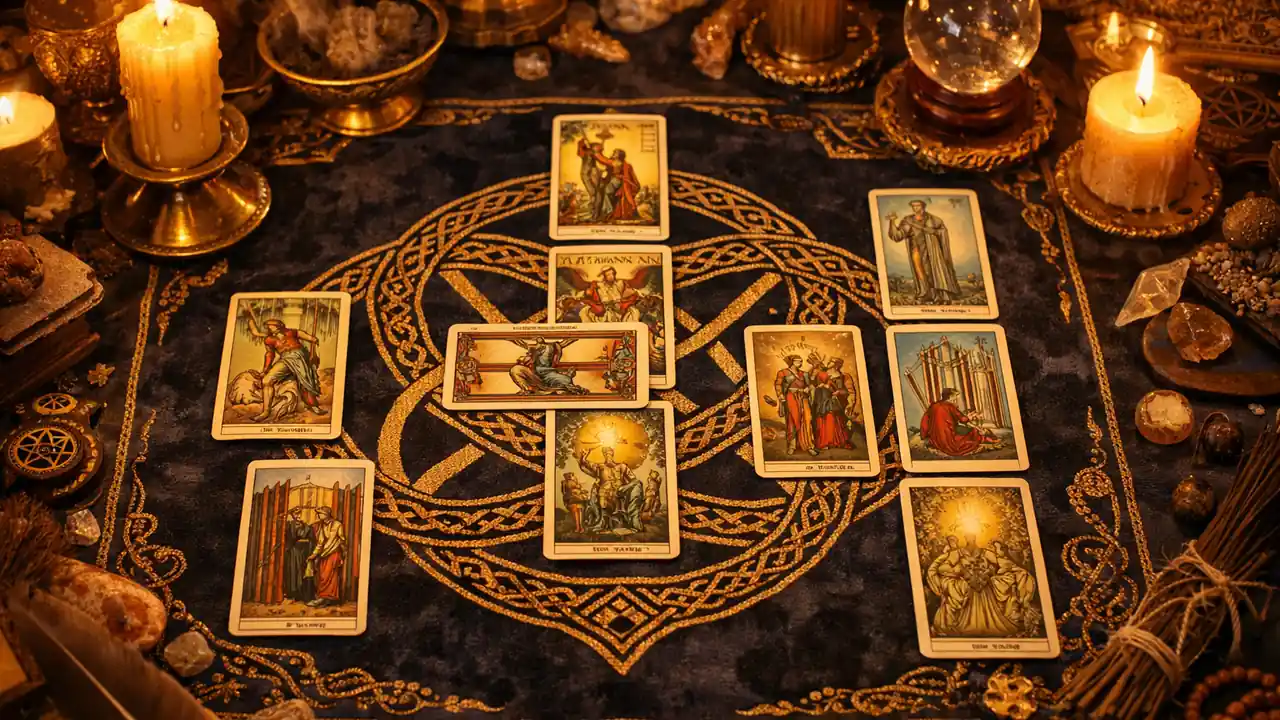
The Celtic Cross is one of the most widely used tarot spreads. Its many positions and layers often confuse beginners. Reading it well comes down to laying the cards in the right order and knowing how each position shapes a card's meaning.
The guide starts with the structure of the Celtic Cross and goes through what each position means and how to read it. It then covers the most common mistakes and ends with a practical reading framework and tips you can use right away.
This applies whether you are new to tarot or have been reading for a while. The methods are concrete, help you avoid misreadings, and add depth to your interpretations.
Key takeaways: a full Celtic Cross spread guide covering the layout steps, the meaning of each position, common mistakes and practical reading techniques, so you can use this classic spread correctly.
Celtic Cross Structure and Basic Layout
The Celtic Cross uses ten cards in two parts: the cross on the left and a column on the right. The cross holds six cards (cards 1–6), which show the heart of the question, the obstacle, and how the situation got here. The right-hand column holds four cards (cards 7–10), which show your attitude, your surroundings, your hopes and fears, and the final outcome. Together they let a reader look at a question from several angles.
The first card goes in the center and represents the present. The second lies across the first and stands for the obstacle or challenge. The third goes to the left of the first and represents the foundation. The fourth goes below and shows past influences. The fifth goes above and represents the possible future, which some readers call the conscious goal. The sixth goes to the right and represents the near future. The four cards in the right-hand column are laid from bottom to top: self-attitude, environment, hopes and fears, and final outcome. Getting the layout right comes first, because cards in the wrong positions muddle the whole reading.
The six cards of the cross
The six cards of the cross are the core of the Celtic Cross: the present (card 1), the challenge (card 2), the foundation (card 3), past influences (card 4), the possible future (card 5) and the near future (card 6). The present card shows where things stand now. The challenge card points to the obstacle or conflict. The foundation card reflects deeper or subconscious factors. The past card gives the background. The possible future shows where things may end up if they stay on their current course, and the near future shows what is likely to unfold next.
The four cards of the right-hand column
The right-hand column has four cards. From bottom to top they show the querent's attitude, their surroundings, their hopes and fears, and the final outcome. This part adds the outer and inner context, so the reader can see the querent's situation and likely direction from more than one angle.
What Each Celtic Cross Position Means
Every card in the Celtic Cross takes part of its meaning from its position, so you can't read a card on its face alone. The six cards of the cross show the nature of the question, the obstacle, and how things got here. The right-hand column adds your attitude, outside influences and your state of mind. Knowing what each position means is the key to the reading.
For example, card 1 is the present. Strength upright there is generally read as the querent currently feeling brave and confident. Reversed, it may suggest inner weakness or a lack of control. Card 2 is the challenge, and The Hanged Man there may point to being stuck or needing a new perspective. Always weigh the card and its position together.
The six cross positions in detail
Card 1 (present): the core of the situation and the starting point for the whole spread. Card 2 (challenge): the obstacle or inner and outer conflict to watch for. Card 3 (foundation): the subconscious side of the question or the deeper forces driving it. Card 4 (past): background, meaning influences that have just left or are fading. Card 5 (possible future): where things may end up if they stay on their current course. Card 6 (near future): what is likely to unfold over the coming period.
The four column positions in detail
Card 7 (self-attitude): how the querent is approaching the question. Card 8 (environment): outside influences, including other people and circumstances. Card 9 (hopes and fears): the querent's state of mind, often full of mixed feelings and inner struggle. Card 10 (final outcome): the likely trend or result if things stay on their current course, not a fixed fate.
How to Ask a Good Question for the Celtic Cross
The Celtic Cross suits complex questions with many sides, but only if the question is specific and clear. A vague or overly broad question leaves the cards with nothing to focus on, and the reading turns fuzzy. Good questions usually focus on the querent's current situation, an inner conflict or a likely direction. They stay open rather than asking for a simple yes or no.
For example, "How is my relationship with my partner likely to develop?" suits the Celtic Cross better than "Will I get married?" because it covers several factors and lets the spread show the full dynamics of the relationship. When you ask, also try to set aside strong hopes or biases. Staying open and objective keeps you from reading only the parts you want to see.
Avoid questions that are too broad or closed
A broad question like "What does my future hold?" covers too much for the spread to focus on, which leads to vague readings. A closed question like "Will I succeed?" only asks for yes or no and wastes the layered analysis the Celtic Cross offers.
How to frame a specific, many-sided question
Keep the question specific and let it cover the querent's inner and outer situation and the likely direction, for example: "What is the main challenge in my career right now, and how might it develop over the next six months?" Questions like this get the most out of the spread.
Common Celtic Cross Mistakes and Misreadings
Many readers assume each card in the Celtic Cross has one fixed meaning and overlook how position and card work together. Another common mistake is leaning too hard on the standard meanings in a guidebook while ignoring the querent's situation and the links between the cards. The result is a shallow reading without much depth.
Some people also treat every reversed card as negative or unlucky. That shortcut narrows what a card can say. A reversal can point to an inner block, untapped energy or something that needs a second look, so it shouldn't be judged the same way every time. Other readers neglect the quality of the question, and the reading loses focus.
Mistake 1: Reading the card and ignoring its position
Each position in the Celtic Cross has its own meaning. Read the card without its position and you are likely to get it wrong. The same card means something very different in the challenge position than in the final outcome position.
Mistake 2: Reading every reversal as negative
A reversed card isn't automatically bad news. It usually signals blocked energy, something to adjust or something to reflect on. Reading reversals too negatively can weigh on the querent and make the reading less useful.
Mistake 3: A vague question that blurs the reading
Without a specific question, the spread can't focus, and the reading comes out one-sided or contradictory. Ask clearly and specifically, and stay open to the answer.
Practical Celtic Cross Reading Techniques and Framework
When you read the Celtic Cross, start with the two center cards to grasp the core issue and the obstacle. Then move around the cross to the foundation, past, possible future and near future, and finally connect the right-hand column's attitude, environment and state of mind. Tie the cards together as one story instead of explaining each card on its own, so the whole context comes through.
As a framework, first note whether each card is upright or reversed. Then combine that with the position's meaning and the querent's background, and finally look at how the cards interact. You can work through them in this order: present → challenge → foundation → past → possible future → near future → self-attitude → environment → hopes and fears → final outcome. Going layer by layer keeps the reading logical and well structured.
Use the cross to find the core issue
Start with the six cards of the cross: present, challenge, foundation, past influences, possible future and near future. They are the base for reading the whole spread.
Add the column for mindset and surroundings
The four right-hand cards show the querent's attitude, surroundings, hopes and fears, and the final outcome. They complement the cross and complete the story.
Weave the cards into one storyline
Link all the card meanings into one coherent story rather than treating them as separate pieces, and the reading gains depth.
Limits of the Celtic Cross and When to Use It
The Celtic Cross is powerful, but it doesn't fit every question. It works well for complex, layered situations such as tangled relationships, workplace challenges and big life choices. For a simple yes-or-no question or a quick short-term decision it is too elaborate and can get in the way of a clear answer.
The Celtic Cross also asks for some knowledge of card meanings and some reading experience. Beginners who don't yet understand the positions can easily misread it. Practicing simpler spreads first and building up to the Celtic Cross is the best way to get the most out of it.
- Suited to complex, many-sided questions
- Not suited to simple yes-or-no or short-term decisions
- Calls for solid knowledge of card meanings and reading skill
- Beginners should build up to it step by step
Ready to put the ten positions to work? Draw a full ten-card Celtic Cross spread and check each card against the position guide above.
Draw a Celtic Cross spread