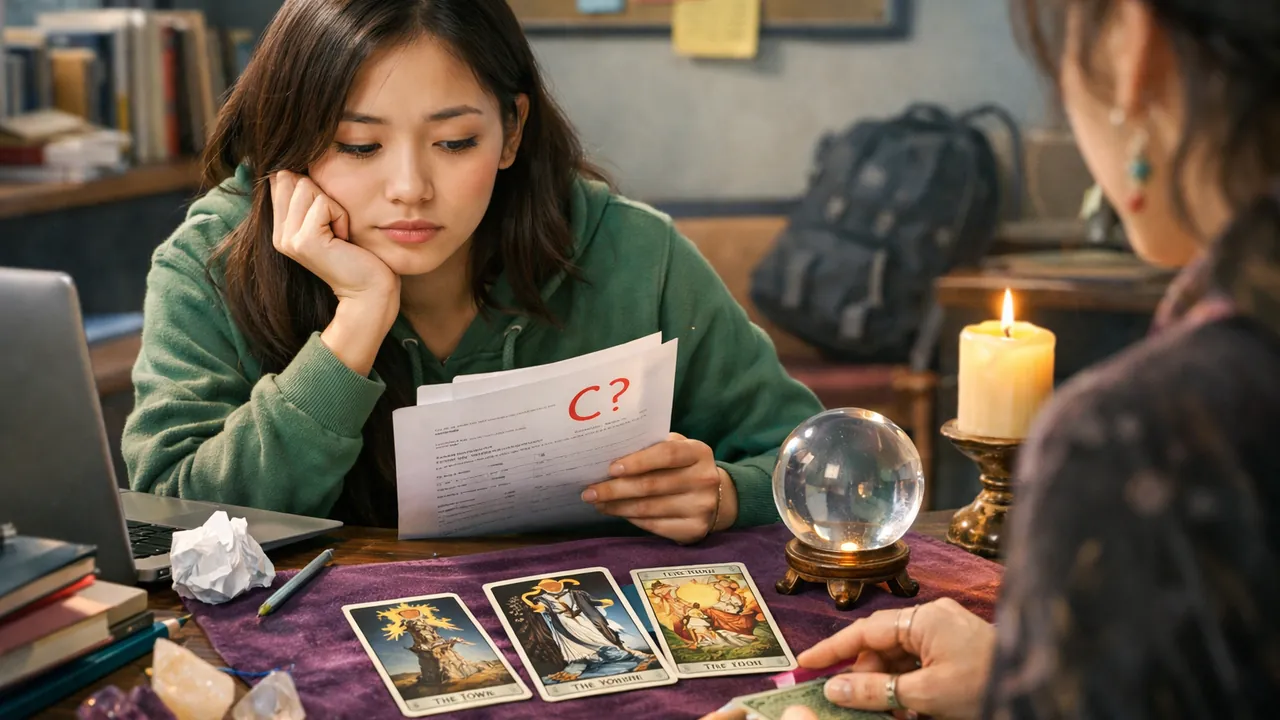
You may have been studying for a while and still can't stop asking: will I pass, will I get in, will my score be high enough? Wanting a clear answer when you're anxious is natural. But if you only use tarot to predict the outcome, you can miss the things that could actually change it.
Below, we first answer whether you can ask at all. Then we help you work out what you really want to know: the result, the risks, how to prepare, or whether to sign up or retake the exam. The cards don't settle your fate. They give you something to turn into a study plan and a test-day strategy.
Key points: you can ask tarot about an exam, but the cards show where things are heading now, not your final score. Change “will I pass?” to “what should I adjust right now?” and check four things with four cards: preparation, blind spots, mindset and recovery. Afterwards, write a study plan with checkpoints. When the cards and your real data disagree, trust the data.
Can tarot predict exam results? Yes, but not as a score forecast
Yes, but first stop thinking of it as a way to learn your score early. Think of it as a check on where things are heading. The cards can reflect how prepared you are, how you handle pressure, how you use your time and where you might get stuck. They can't replace your actual score, the admission cutoff or the grading.
Tarot is useful when the real decision is whether to sign up, whether to retake, or how to spend the time you have left. It won't tell you that you'll definitely pass or definitely fail. It helps you see what most needs fixing now, so the anxiety turns into action.
Change “will I pass?” to “what should I adjust now?”
If you only ask “will I pass?”, a single card starts to feel like a verdict. You relax when you draw The Sun and fall apart when you draw the Nine of Swords. Better questions are: “What is affecting my exam performance most right now?”, “Where in my preparation am I most likely to lose points?” and “What should I focus on over the next two weeks?” If you're still learning the cards, start with the complete guide to all 78 tarot card meanings.
- Good to ask: how prepared you are, test-day risks, study strategy, what to fix first.
- Not good to ask: your exact score, whether you're certain to get in, or anything that hands every decision to the cards.
- An example of what not to ask: “Will the examiner happen to set the questions I know?” The answer is completely outside your control, and the cards can't give you a next step you can act on.
Decide whether you're asking about the result, the risks or what to do
Before you draw, ask yourself: do you want to know whether you'll pass, or where things might go wrong? Those are very different questions. Result questions usually come from anxiety. Risk questions help you find out why you lose points. Action questions lead straight to your study schedule and last-minute fixes.
You can split an exam question into three layers: your current odds, what's holding you back, and what to do next.
How to tell the three kinds of question apart
If you're asking about the result, read the answer as a trend based on where you stand now. Then check whether you've done past papers and practice tests and worked on your weak subjects. If you're asking about risks, look for signs of procrastination, distraction, overconfidence or anxiety wearing you down. If you're asking what to do, turn the card meanings into concrete tasks: more essay practice, a better sleep schedule, a new review order, or dropping a study method that isn't working. The Major Arcana tend to point to the big picture and the emotional side, while the Minor Arcana fit the day-to-day details of preparation.
- Result: How is my path to passing this exam looking right now?
- Risk: What is most likely to cost me points or throw me off on the day?
- Action: Which part of my study strategy should I strengthen first?
It also helps to read the cards together. If the result card looks good but the state card looks poor, there's a real chance, but deal with fatigue, careless mistakes or time management first. If the result card is so-so but the action card is clear, don't jump to pessimism; follow the cards' hints and shore up what you can control.
The most common exam reading mistakes: verdicts, repeat draws and skipping study
Before you draw, avoid three habits that most often make a reading go wrong. The first is treating one card as the verdict on your exam. The second is asking the same question again and again because you still feel uneasy. The third is drawing cards instead of studying, which seems to calm the anxiety but moves your preparation nowhere.
If The Sun makes you relax and The Tower makes you give up, the card has gone from a reminder to an order. Whatever deck you use, read the card against your real situation.
Fix the question first, then read the cards
When you want to ask “will I pass?”, change it to “what is most likely to affect my performance?”, “which part of my preparation is most likely to cost me points?” or “what should I adjust over the next two weeks?” If you've already asked once, don't draw for the same question ten minutes later. Make the second question a follow-up instead, such as “how can I reduce the risk this card points to?”
- Don't treat one good card as a guarantee: a positive card usually means things are in place and moving well, but you still have to review, take practice tests and manage your time.
- Don't treat one hard card as the ending: difficult cards usually point to procrastination, imbalance, too much tension or the wrong method, and the point is to fix it now.
- Don't treat a reversed card as automatic failure: reversals more often point to feeling stuck, delays, overdoing it or a need to internalise something. When you see one, look back at your study habits and how you're doing on exam day first, rather than deciding you won't pass.
- Don't use readings to avoid action: if a reading doesn't lead to a study plan, a review of your mistakes or a rest plan, it has only stretched out your anxiety.
Practical questions and a spread: preparation, blind spots, mindset and recovery
You can turn a reading into a pre-exam checklist. The simplest way uses four cards. The first shows how prepared you are now. The second shows the blind spot where you most easily lose points. The third shows your mindset and test-day risks. The fourth shows the most effective way to recover. Asking this way gives you a plan, which asking about pass or fail doesn't.
Before you draw, write down the exam, how many days are left, where you are and which subject worries you most, so the cards have clear context. When you read them, don't just ask whether a card is good or bad; look at its position too. The Eight of Swords in the mindset position may mean anxiety is holding you back, while in the blind-spot position it may mean you're stuck on understanding a type of question.
How to use the four-card exam check
Shuffle and set a time frame, for example “my preparation over the next fourteen days.” Turn over the four cards and note them in order. The preparation card shows whether your foundation is solid. The blind-spot card points to a subject, question type or habit you've been ignoring. The mindset card shows your stress, sleep and composure on the day. The recovery card has to become a concrete action, such as redoing wrong answers, scheduling a mock exam, asking a teacher or dropping a study method that isn't working.
- A question you can use: “What part of my exam preparation needs the most work right now?”
- A question you can use: “If I keep studying the way I am, where am I most likely to lose points?”
- A question you can use: “What one action over the next week would make me steadier?”
- After the reading, write three next steps: one change to how you study, one mock test or review, and one way to look after yourself.
A variation: if your mindset is fairly steady, you can swap the third card, the mindset position, for a resources position: a teacher, a question bank, a study group or skills you've already built. That way the spread shows you directly what you have to work with. Get comfortable with the basic version first, though; the 30-day example below still uses the original four positions.
Example: four cards, 30 days before a major exam
Say a big licensing exam is 30 days away and you ask, “What does my preparation most need to change over the next 30 days?” The four cards, in order, are the Eight of Pentacles (preparation), the Eight of Swords (blind spot), the Ten of Wands (mindset) and Temperance (recovery). The Eight of Pentacles suggests your foundation is building and you're studying enough each day. The Eight of Swords as the blind spot is a reminder that a question type or concept may have you boxed in, so you keep going over what you know and avoid your weakest subject. The Ten of Wands in the mindset position shows you're carrying too many subjects at once and the pressure is hurting your efficiency. Temperance in the recovery position suggests rebalancing how you split your time, not adding more hours.
Read together, the cards don't say whether you'll pass. They point to what to change over the next 30 days: give your weakest subject more time, take one timed mock test a week and keep a regular sleep schedule. Two weeks in, check whether the types of mistakes you make have gone down, then decide whether to push ahead or keep working on weak spots.
Which card signals to watch: pre-exam warnings from the Major to the Minor Arcana
Once you've drawn your four cards, look at what kind of risk they're warning about. Major Arcana cards usually work like big warning lights, pointing to your overall state, how you handle pressure or a turning point. Minor Arcana cards are closer to everyday study habits: time management, how much you practise, how well you retain material and how you feel on the day.
Don't rush to sort the cards into good and bad. Ask what concrete action a card is asking you to change, given whether it sits in the preparation, blind-spot or recovery position.
Turn card meanings into an exam check, not a good-or-bad verdict
For example, The Magician in the preparation position may mean you have the resources and the methods, but it also reminds you to actually connect your notes, question bank and schedule. The Hanged Man in the blind-spot position may mean you're stuck in an old study method and won't try different types of questions. The Hierophant in the preparation position may remind you to go back to standard materials and your teacher's advice. The Hermit in the blind-spot position may point to working through weak spots on your own. When Strength appears, it's a reminder to steady the pressure and get your pace back. Pentacles often relate to steady progress. Swords often point to thinking, anxiety and how you reason through answers. Wands are about drive and momentum. Cups ask you to watch your emotions, confidence and support before the exam. To brush up on meanings, see the 22 Major Arcana card meanings.
- Favourable cards like The Sun, The World or The Chariot don't mean you can stop studying. They suggest turning your strengths into mock tests, full reviews and consistent performance.
- Pressure cards like The Moon, the Nine of Swords or the Ten of Wands don't mean you'll fail. They remind you to deal with sleep, anxiety, overload and the risk of freezing on the day.
The limits of divining exam results with tarot: it can't replace study, entry rules or test-day surprises
You can ask tarot about an exam, but don't let the cards overstep. Tarot can help you see your study strategy and state of mind. It can't work through your question bank, understand the textbook, memorise the material or practise your essays for you, and it can't change the rules of the exam.
This matters most for exams with fixed places, pass marks, eligibility checks or score cutoffs: tarot can't get you past those requirements. Even if the cards look smooth, you still need to check your eligibility, the exam rules, how marks are weighted and what past papers look like. Even if the cards look heavy, they may only reflect how stressed you are now, not the final result.
Use the limits as boundaries for your decisions
A safer approach is to sort the reading into three layers. The first is what you can control: study hours, review order, how often you take mock tests. The second is the risks you can reduce: sleep, getting to the venue, your materials, time management. The third is what you can't guarantee: the questions, how strictly it's graded, how others perform. If a card speaks to the third layer, don't treat it as a promise. Go back to the first two layers and set checkpoints you can actually meet.
- If the cards make you more anxious, stop drawing and do a timed practice round or go over your mistakes, so you're the one in control again.
- For big decisions about further study, certifications, studying abroad or your career, also look at official information, advice from teachers and your own score record. Don't decide on a reading alone.
- If you're already dealing with severe insomnia, panic, being unable to eat or constant self-blame, tarot shouldn't take the place of professional help. Please talk first with your school's counselling service, a therapist, a doctor or an adult you trust. A reading can keep you company while you sort through your thoughts, but what really protects your exam performance is still sleep, practice, how you plan your time, and your physical and mental safety.
After the reading: turn it into a study plan, practice tests and a decision list
After you draw, don't rush to label the cards good or bad. Turn each card into an action you can test. If you draw Swords, for example, don't just say you're stressed. Check whether you're mixing up concepts, reasoning unclearly in your answers or not correcting enough practice questions, then plan specific fixes.
You can organise the reading into three columns: what the card signals, what the real evidence shows, and the next step. If the cards suggest your time is badly balanced, look back at your study log and where your mistakes cluster. If they suggest test-day nerves, schedule timed practice and regular breaks.
A second check to decide: push harder, adjust, rest or rethink
The second check means placing the cards on your exam timeline. If the exam is still weeks away, Wands and Pentacles signals can usually become checks on how much you're doing and how consistently. If only a few days are left, don't switch materials. Focus on common question types, going back over mistakes and getting your sleep right. In the final three days, avoid doing a big reading every day. A single daily card as a reminder works better, leaving your time for review, sleep and exam-day preparation. If a Major Arcana card with a strong sense of upheaval appears, such as The Tower or Judgement, you don't need to read it as failure. It's a reminder to face the situation: do you need to drop a method that isn't working, ask a teacher for help, change your exam plan or prepare a backup?
- Write each card as an action: for example “take three timed mock tests this week and note why each wrong answer was wrong,” not just “the card says I'll be nervous.”
- Set checkpoints: after three days, look at your study hours, accuracy, types of mistakes and sleep, then decide whether to draw again or change the plan.
- If the cards contradict the real evidence, trust the evidence. Tarot is a reminder; it doesn't overrule your scores, the cutoffs or how much you've prepared.
- Make your exam-day strategy concrete: scan the paper first, budget your time, skip questions you're stuck on and leave time to check at the end, so the cards' reminders become a process you can follow.
- Check the cards against your error log: if they say your basics are shaky, don't just reread summaries. Work through basic questions and past papers to cross-check, then see whether the problem the cards pointed to is really there.
- If you want to ask again after the exam, ask “what study patterns did this exam reveal?” or “what skill should I build first for the next round?” rather than asking again and again when the results will come out.
References
Want to get clear on your exam prep? Write your current progress and the subject that worries you most into one question, draw the cards, and see what's holding you back and what to work on next.
Ask your question and draw