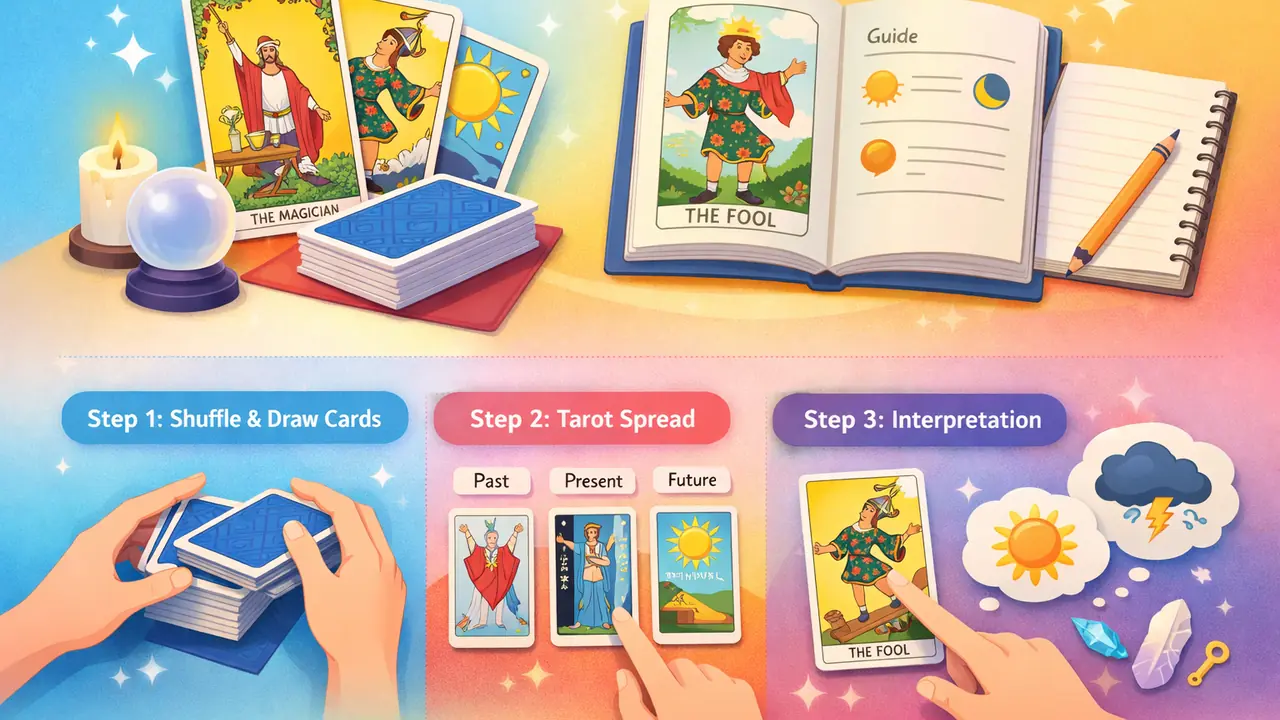
Tarot is more than a fortune-telling tool. It works as a bridge to what sits beneath your conscious thinking. Many beginners get stuck in the gap between memorized card meanings and real readings, and the result is a reading that feels vague. Learning the core meanings and a few interpretation habits is the first step toward clearer readings.
This guide covers the basic upright and reversed meanings, what to focus on when reading for love and career, and the common mistakes and misconceptions new readers fall into. It gives you a concrete framework and practical methods you can use in everyday readings, so you avoid misreading the cards or losing your direction.
Whether you are brand new to tarot or a hobbyist who wants more depth, this guide starts from the core meanings and builds toward practice, giving you a solid base for reading tarot and for more advanced study later on.
Key takeaways: this beginner guide walks through tarot basics and core card meanings, from upright and reversed positions and love and career readings to practical techniques and common pitfalls, helping you grasp the essentials of tarot reading and apply them with more confidence.
Upright and Reversed Tarot Meanings Explained
Tarot is one of the most widely used card systems in modern divination, with a clear structure and rich symbolism. Each card carries a noticeably different meaning upright and reversed. Upright usually expresses the positive or neutral side of the card, while reversed may point to obstacles, delays or inner conflict. Understanding this difference is the foundation of a clear reading.
Take The Fool as an example. Upright, it is generally interpreted as a new beginning, adventure and freedom; reversed, it warns of recklessness, a lack of planning or an immature decision. Separating upright from reversed helps you see both sides of a situation instead of flattening it into one simple answer.
- Upright cards usually suggest positive, smooth energy
- Reversed cards point to obstacles, reflection or hidden issues
- Always weigh upright and reversed against the spread and the question
Upright meanings in detail
An upright card usually carries active, smooth or positive energy. The Sun upright, for instance, is generally read as success, joy and clarity, hinting that things are moving in a good direction. Upright meanings can boost a reader's confidence and point toward a clear course of action.
Reversed meanings in detail
Reversed meanings tend to carry a warning or a challenge: blockages, inner contradiction or outside pressure. Death reversed is not necessarily bad news, but it may suggest resisting change or feeling stuck. Read reversals in the context of the whole spread and the question, and avoid turning them into pure doom.
How to Read Love and Career Messages in Tarot
Reading tarot for love or career means looking at a card's symbolism together with its position in the spread. Love readings tend to focus on emotional states, how people interact and where a relationship is heading; career readings look at goals, challenges and growth potential. Beginners should learn how the same card can mean different things in different areas of life.
The Lovers, for example, generally points to a deep emotional bond and a meaningful choice in a love reading, while in a career reading it may stand for an important partnership or decision. Knowing how each card speaks to different areas helps you answer the actual question being asked.
- Love readings focus on emotional interaction and relationship status
- Career readings focus on goals, challenges and development
- The same card can carry different meanings in different areas
What to focus on in love readings
Love meanings center on emotional flow, communication and relationship dynamics. Upright cards often suggest a relationship that is going well and feels stable, while reversed cards may hint at misunderstandings, distance or an emotional rough patch. Notice how the figures on the card relate to each other and what objects surround them; these details help reveal deeper emotional messages.
What to focus on in career readings
Career meanings lean toward reaching goals, workplace challenges and personal growth. Upright cards often point to opportunity and success, while reversed cards may reveal obstacles, pressure or a poor decision. Connect the reading to the person's job and current situation instead of giving generic advice.
Common Tarot Mistakes and Myths for Beginners
Many beginners assume tarot can predict the future directly, overlooking that it mainly reflects present energy and possible trends. Leaning too hard on literal keyword meanings, without adapting them to the situation, is one of the most common mistakes. Ignoring reversed cards or reading too much into negative messages can also cloud a reading.
Another myth is that spreads are fixed and can never be changed. In practice, a spread can be adjusted to suit the question and the purpose of the reading. Beginners should avoid rote memorization and instead build a connection between their intuition and the symbols on the cards; that is where tarot becomes most useful.
- Tarot is not an absolute prophecy; it is for guidance and reflection
- Ignoring reversed meanings leads to one-sided readings
- Building intuition beats memorizing meanings word for word
- Spreads can be adapted to the question
In Practice: How to Draw Cards and Ask Questions
Drawing cards and asking the question are the key steps of any tarot reading, and doing them well helps the meaning come through clearly. Make your question specific and focused rather than vague or overly broad. For example, instead of "What will happen in my love life?", try "How might my relationship with my current partner change over the next three months?" for clearer guidance.
Stay calm while drawing and keep your attention on the question; this helps you connect with what lies beneath the surface. There are many ways to shuffle, so choose one that feels comfortable and lets you focus. After drawing, read the cards in the order of the spread, combining card meanings with intuition.
How to ask an effective question
Avoid yes-or-no or vague questions. Open, specific wording lets the cards show more layers. "How can I improve my relationship with my coworker?" opens up a far deeper reading than "Will my coworker and I make up?"
Drawing process and mindset
Before drawing, take a deep breath, set aside distractions and focus on the question. You can repeat the question silently while shuffling to keep your focus. After drawing, stay open-minded, avoid jumping to conclusions and let the meaning unfold naturally.
The Limits of Tarot Reading You Should Know
Tarot can be powerful, but it is not all-powerful. It cannot replace professional medical, legal or financial advice, and it should never be used to control someone else. Tarot mainly offers insight from your inner mind and a view of possible trends; the final decision always rests with you. Knowing these limits helps you avoid misuse and over-reliance.
A reading is also shaped by the asker's state of mind, the choice of spread and the reader's experience, so interpretation always carries some subjectivity. Staying rational, thinking critically and combining the reading with your own judgment is how you get real value from tarot.
- Tarot does not replace medical or legal professionals
- It should not be used to control or pressure anyone
- Readings contain a subjective element
- You remain responsible for your own decisions
Advanced Tips to Read Tarot More Clearly
Beyond knowing the meanings, the key to clearer readings is bringing together intuition, card imagery and the context of the question. Practice noticing colors, facial expressions and symbolic details on each card, and link them to the asker's current situation to catch deeper messages. Regular practice and reflection help you develop your own reading style.
Learning the structure and purpose of different spreads also lets you approach a question from several angles. Try keeping a record of your readings and their outcomes, then look back to check them; this helps you refine your framework and avoid rigid thinking. These habits make your readings more flexible and more insightful.
- Combine intuition with card details for deeper readings
- Learn the structure and meaning of different spreads
- Reflect and keep records regularly to sharpen your judgment
Observing card details
Pay attention to where the figures look, how they stand and what surrounds them; these details often reveal emotions and hidden messages. The lantern held by The Hermit, for example, is generally read as guidance and introspection, and small differences like this can change the layers of a reading.
Spread structure and multi-angle analysis
Each spread, such as a three-card spread or a cross spread, assigns a role to every position. Understanding what each position means helps you link the cards into one coherent story. Looking from several angles keeps a single card from misleading you and adds depth to the whole reading.
Want to see what the cards mean in your own situation? Bring the question on your mind and draw three cards. It usually feels more personal than reading keywords alone.
Start a Tarot Reading