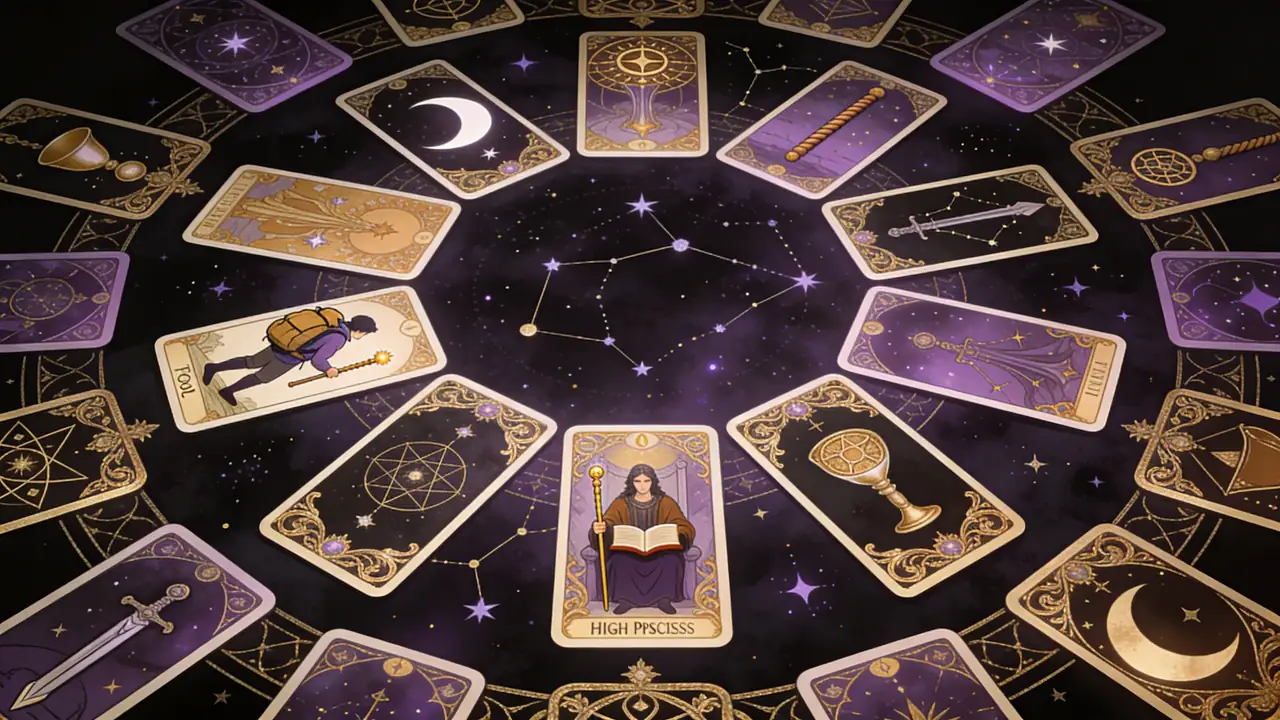
The 22 Major Arcana cards are the most symbolic group in a tarot deck. Together they describe the soul's journey from innocence to awakening, and knowing what these 22 cards mean sits at the heart of tarot reading. Each card carries different upright and reversed meanings, along with psychological and spiritual layers, so it only makes sense when read against a specific question and spread position.
Below, each of the 22 Major Arcana cards is broken down: its core symbolism, upright and reversed readings, and how it applies to love and career. Common misunderstandings are cleared up along the way, with a working framework and practical steps so you can use this map of the inner life flexibly in real readings.
Whether you are new to tarot or already reading regularly, understanding the deeper meaning of these 22 cards and how to weigh them helps you respond more clearly to life's challenges, see the shape of your own inner growth, and bring more depth and focus to each reading.
Key takeaway: this guide covers the upright and reversed meanings of all 22 Major Arcana cards, shows how each one plays out in love and career, corrects common misreadings, and offers concrete methods for following the Fool's Journey of inner growth.
Core Symbolism and Structure of the 22 Major Arcana
The Major Arcana is made up of 22 cards, starting with The Fool, numbered 0, and ending with The World, numbered 21. These cards are generally interpreted as stages of human growth and the journey of a life, moving through innocence, exploration, trial, awakening and integration. Every card is rich in symbols that reflect psychological and spiritual themes. The system was organized by esoteric circles in the late 19th century and later spread widely through the tarot decks most readers know today.
The 22 cards fall into three broad parts: the beginning of the Fool's Journey (such as The Fool and The Magician), the trials and transformations of the middle stretch (such as Death and Temperance), and the completion and integration at the end (such as Judgement and The World). This structure is more than a fortune-telling tool. It reads like a psychological script that helps you recognize the key lessons and turning points in a life. Understanding the basic symbolism of each card is the first step toward a clear reading.
Where the Fool's Journey Begins and Ends
The Fool stands for innocence and open possibility. It is the starting point of the journey, linked to adventure and fresh beginnings. The World stands for completion and wholeness, the point where the self comes together. These two cards mark the two ends of the road, from not knowing to awakening.
The 20 cards in between describe the challenges and lessons met along the way. Strength points to inner courage, and The Hermit to reflection and wisdom. Each is a stage the soul passes through.
Symbols and Psychological Meaning
The imagery on each card is carefully built and is often linked to Jung's idea of archetypes in the collective unconscious. Death, for example, is not usually read as literal death but as the end of something old and the transformation that makes room for the new. This depth is what makes the Major Arcana such a useful tool for self-reflection.
Knowing the symbols and their cultural background helps you read each card more precisely and avoid stopping at the surface meaning of its name.
Basic Principles for Upright and Reversed Cards
Reading the Major Arcana means paying attention to both upright and reversed positions. Upright cards usually show the positive side of a card or energy that is openly expressed. Reversed cards may point to blocks, inner conflict or something not yet mature. This two-sided approach makes each card richer and more flexible to read.
A reversed card is not automatically bad news, though. Sometimes it simply asks you to look inward or change direction. Getting the difference between upright and reversed right is key to avoiding misreadings.
What Upright Cards Mean
An upright card usually expresses the card's original energy. The Magician upright, for instance, is generally interpreted as creativity and the drive to act, suggesting the person has the ability and resources to reach a goal.
Upright meanings tend to carry encouraging messages, but they still need to be read against the background of the question.
The Many Readings of Reversed Cards
A reversal can suggest blocked, excessive or lacking energy. Strength reversed, for example, may hint at low confidence or emotions running out of control.
It can also point to a hidden issue beneath the surface, a prompt to reflect or change rather than a final verdict.
Major Arcana Meanings in Love Readings
In love readings, the Major Arcana often reveals the core theme of a relationship and the deeper bond between two people. The Lovers upright is generally interpreted as sincere love and a conscious choice, while reversed it may point to contradictions in the relationship or a poor decision.
To see what stage a relationship is in and what risks it carries, read the card alongside its spread position and the cards around it.
The Lovers and Choices in Love
The Lovers stands for choice and harmony in love. Upright, it suggests both people are being honest with each other and the bond feels steady. Reversed, it may show hesitation, outside interference or mismatched values.
Reading the card this way can help someone see where the relationship is heading and make a wiser decision.
Death in Love Readings
Death is often misread as a definite ending. In love readings it more often points to transformation and renewal: an old pattern coming to an end so that something new can begin.
Seeing this layer helps you avoid panic and meet changes in the relationship with a clearer head.
Career and Life Direction Readings
In career readings, the Major Arcana speaks to deeper purpose and life direction. Justice, for example, is generally interpreted as fairness and responsibility, suggesting that integrity matters at work right now.
Different cards point to the challenges and openings of different stages, helping the person adjust their approach and find a path that suits them better.
The Magician and Creative Drive at Work
The Magician upright points to creativity and the ability to pull resources together, suggesting the person can seize an opportunity and reach a goal.
Reversed, it may hint at a poorly thought-out plan or a lack of confidence, a reminder to review the strategy.
The Hermit and the Value of Reflection
The Hermit stands for seeking inner wisdom. At work, it may mean it is time to pause and reflect rather than push ahead blindly.
Listening to The Hermit helps you avoid rushing and find a direction that holds up over the long run.
Common Mistakes and Myths in Reading the Major Arcana
Many people assume Major Arcana meanings are fixed, ignoring how spread position, orientation and the question itself shape a card. That leads to readings that are oversimplified or simply off.
Another common mistake is treating every reversal as purely negative and missing its value as a prompt to adjust and reflect. Leaning too hard on single-card meanings while ignoring how the whole spread interacts is another reason readings go wrong.
- Card meanings are not absolute; read them with the spread and the question
- A reversal is not bad news by default; it is often a warning or a chance to grow
- Ignoring the links between cards makes it easy to miss the deeper message
How to Read and Apply Major Arcana Meanings in Practice
When reading a Major Arcana card, first note whether it is upright or reversed, then bring in its spread position and the question asked, and look at both the card's symbols and its psychological message. Reading on several layers is what lets a reading speak to the real question.
In practice, start by getting familiar with each card's basic meaning, then practice combining it with spreads and specific questions, building a reading style that balances intuition and logic.
How to Ask for a Useful Answer
A clear, specific question helps the Major Arcana focus its message. 'How should I handle the difficulty in my relationship right now?' gives the cards more to work with than 'Will I be happy in the future?'
Avoid questions that are too vague or that bundle several questions together, so the cards can speak to the core issue.
Using Spreads for Deeper Readings
Choosing a suitable spread, such as a three-card spread or a cross spread, helps clarify the timeline, the influences at play and the likely trend, making the Major Arcana's message more concrete and actionable.
The structure of a spread shows the role each card plays in the larger story, so no card is read in isolation.
Limits and Boundaries of Major Arcana Meanings
The Major Arcana runs deep, but it is not an answer to everything. It reflects soul-level themes and has limited power to predict specific details or short-term events, so it works best alongside the Minor Arcana or other tools.
The reader's experience and intuition also shape how well a reading lands. Relying on literal card meanings while ignoring a person's actual situation easily leads to misreadings. Knowing these limits helps you treat tarot guidance with a level head.
References
Curious how these major cards read in your own situation? Bring a question you are facing now, draw three cards, compare what the reading says about each card, then come back here to look up the meanings.
Start a Tarot Reading