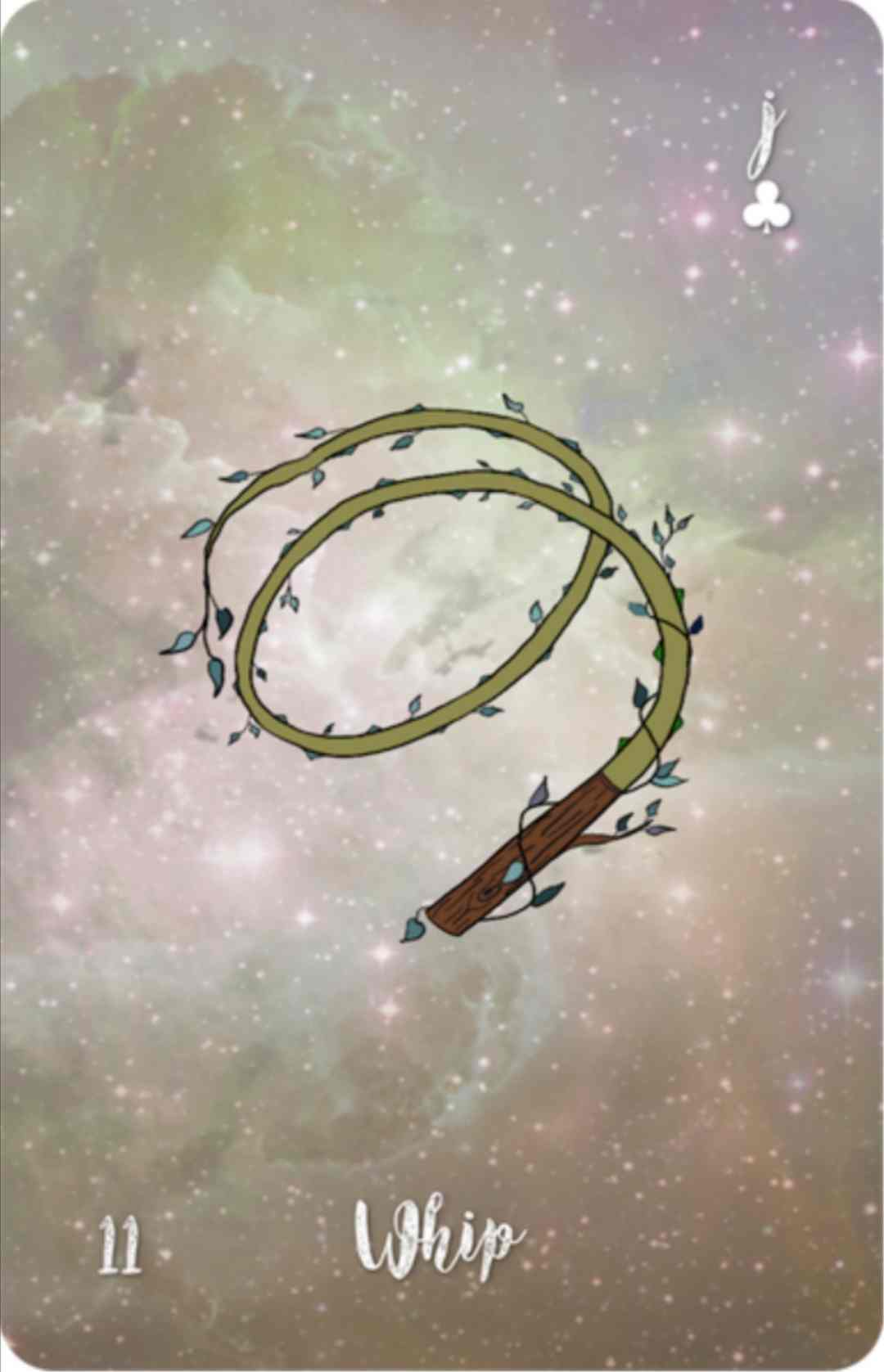
Whip card meaning at a glance
The Lenormand Whip card (No. 11) represents patterns of repetition, arguments, pressure and repeated practice, and may point to the same issue being triggered again and again. It reminds you to find the cause of the cycle so you can tell whether it is a necessary trial or an ongoing drain.
- Core
- Arguments, repetition, trials
- Love
- Recurring fights call for a new way of communicating.
- Career & money
- Deal with disputes at work and watch for swings in pay and cash flow.
- Yes or no
- Leans no. Stop the back-and-forth and set concrete rules instead.
Yes-or-no answers are based on the card's general tendency on its own; always combine them with your question and the neighboring cards.
Basic symbolism and core meaning of the Whip card
The Whip is card number 11 in the Lenormand deck. Its traditional image shows one whip or two crossed whips, sometimes drawn as a broom or a rod. The image conveys its core energy directly: repeated motion, applied force and a process that comes with some pain. A whip is not a single blow but a rhythm of strikes again and again, which is exactly why it is so closely tied to the keyword "repetition." In a reading, the Whip often points to patterns that keep cycling and are hard to stop. If you have something on your mind that you want to sort out soon, you can bring your question to an online Lenormand reading, draw your cards and see what the Whip means in your own situation.
On a symbolic level, the Whip also carries the meaning of "trials." Just as forging metal takes repeated hammering, people are tested over and over in certain hard situations. When the Whip appears, it does not always signal a purely negative event. It works more like a mirror, reflecting the friction, tension and unresolved conflict in your current situation. To understand this card, first set aside your fear of conflict and ask yourself instead: what is this recurring pattern actually trying to tell me?
- Core keywords: arguments, repetition, trials, conflict, cycles
- Traditional imagery: crossed whips, a broom, a rod
- Energy: ongoing, repetitive, full of friction
- Card number: 11, in the middle section of the deck
- Related situations: quarrels, repeated mistakes, strict training, sexual activity (in certain contexts)
Traditional symbolic details of the Whip card
In early Lenormand decks, the Whip sometimes shared its image with a broom, and both carry the idea of "sweeping away" and repeated motion. Some decks depict it as a riding crop, stressing the power to drive and to force. However the image changes, the core symbolism always centers on repeated behavior, actions that apply pressure, and the sense of conflict or wear that results.
The energy of the Whip card
The Whip's energy is dynamic and ongoing. Unlike a sword-like card that stands for a single cut, it describes a state that is still in progress. This energy can be external, such as an argument with someone else, or internal, such as a self-critical voice that keeps echoing. Working out which direction this energy is moving in is the most important task when reading the Whip.
Whip card meaning in love readings
In a love reading, the Whip's most direct message is that the relationship has recurring fights or quarrels. These are not one-off clashes but a patterned kind of arguing, where both people may keep tugging back and forth over the same issue without ever finding a real way out. If you draw the Whip in a love spread, it is worth thinking seriously: is there a core problem in this relationship that has never truly been dealt with, only triggered again and again?
Yet the Whip does not carry only negative meanings in love. In some contexts it can also stand for intense passion and strong sexual attraction: the tension between two people may come with friction, but it is also full of life. And if you are asking whether a relationship is worth continuing, the Whip may be reminding you that this relationship is testing you. Trials themselves are sometimes the necessary price of growth; the key is whether the process brings real progress or is just an endless drain.
- A pattern of recurring fights or quarrels
- Tension and strong attraction in the relationship
- Repeated relationship habits that need examining
- Communication styles that need adjusting and improving
- Growth through trials vs. an endless drain
Whip card meaning for singles
For singles, the Whip may point to a recurring relationship pattern, such as always attracting the same type of partner or repeating the same mistakes in love. Here the card is an invitation to pause and examine your relationship habits instead of going around in the same circle. Sometimes the Whip also hints that someone you are about to meet has a strong personality, and your interactions will have obvious sparks and friction.
The Whip card in committed relationships
If you already have a partner, the Whip often points straight at communication problems. You may keep arguing over a particular issue without really listening to each other. The card does not advise avoiding conflict; it suggests finding a more effective way to communicate so that arguments actually bring change, rather than just venting and wearing each other down.
Whip card meaning for career and money
In career readings, the Whip usually points to conflict and pressure in the work environment. This may be friction with coworkers or a boss, or a problem that keeps coming up in your workflow and leaves you exhausted. If you are considering a new job or partnership, the Whip is a reminder: before you step into that environment, assess whether its culture of conflict is something you can handle.
Seen from another angle, the Whip in career readings can also represent strict training and an intense work pace. Skills that take repeated practice to master, or goals that require sustained effort to reach, all match the Whip's energy of "trials." As for money, the Whip may hint at repeated financial ups and downs, or money pressure caused by disputes such as contract disagreements or salary negotiations.
- Workplace conflict or friction with coworkers
- Recurring work problems or process obstacles
- Intensive training and honing your skills
- Financial swings or money-related disputes
- Tense situations around contract disputes or salary negotiations
The Whip card in everyday life
In everyday readings, the Whip often points to some irritating situation that keeps repeating. It may be an argument that happens over and over at home, or a habit or behavior pattern that bothers you or the people around you. Here the card works as a warning light, reminding you to notice conflicts that have become habits and to think about whether change is possible and needed.
On the health side, the Whip is sometimes linked to chronic pain, recurring symptoms, or conditions that need long-term rehabilitation. It may also point to overwork or a body that has been under strain for a long time. Psychologically, the Whip can represent an inner self-critical voice: the mental pattern of constantly blaming yourself and replaying past mistakes. Recognizing that this pattern exists is the first step toward change.
- Recurring arguments in the family or in relationships
- Troublesome habits or behavioral patterns
- Chronic pain or recurring health issues
- Overwork and long-term stress
- An inner pattern of self-criticism
Key Whip card combinations
The heart of Lenormand reading lies in how cards combine; a single card's meaning can change noticeably depending on the cards next to it. The Whip's combinations are especially worth understanding in depth, because its core energy (conflict, repetition) can take on very different faces in different pairings: sometimes a warning, sometimes guidance, and sometimes even positive motivation.
Below are the Whip's most common and most representative combinations. Each one offers a concrete direction for interpretation to help you make sharper judgments in real readings.
- Whip + Heart: heated fights in love, but possibly also a passionate relationship; look at the whole spread to judge whether it is passion or hurt
- Whip + Book: repeated study or exam pressure; it may also point to a hidden conflict or secret dispute that has not yet surfaced
- Whip + Fox: be careful of being used or deceived; it may also mean dishonest competition or scheming behind your back at work
- Whip + Sun: conflict ultimately leads to a positive result; success follows the trials, and effort and persistence pay off
- Whip + Cross: long-term suffering and repeated trials; this pairing suggests a difficult situation may take longer to get through
- Whip + Bouquet: making up after a fight, or a turn toward tenderness and kindness in a tense relationship
- Whip + Snake: a complicated conflict that may involve a third party or betrayal; the tension in the relationship carries an element of deceit or manipulation
- Whip + Stars: repeated effort will eventually bring hope; even if the process is hard, the direction is right and persisting is worthwhile
FAQ
If the Whip card shows up in a love spread, does it mean the relationship is definitely going to end?
Not necessarily. The Whip represents a pattern of conflict and repetition, not a verdict that things are over. It is more of a reminder that there is friction in the relationship that needs to be faced. If both people are willing to confront the problem and change how they communicate, the Whip's energy can turn into growth after the trial. What you really need to worry about is when the Whip appears together with cards of separation or endings (such as the Coffin or the Cross); that is a much stronger warning sign.
Lenormand cards have no reversals, so how do I tell whether the Whip has a positive or negative meaning?
Lenormand cards indeed have no reversed meanings. Whether the Whip reads positive or negative depends mainly on three factors. First, the nature of the neighboring cards: next to positive cards (such as the Sun or the Stars), the Whip's energy of trials tends to lead to good results; next to negative cards (such as the Cross or the Snake), it intensifies the sense of hardship. Second, the context of the question: whether you are asking about love, career or health shapes the direction of the reading. Third, its position in the spread: the Whip in an "outcome" position means something very different from the Whip in an "obstacle" position.
The Whip card came up in my career reading. Should I quit my job?
The Whip itself is not a signal to quit; it mostly describes conflict or high pressure in your current work environment. Before deciding, look at the cards next to the Whip: if they are cards of new beginnings (such as the Ship or the Birds), it may indeed be time for a change; if they are cards of stability (such as the House or the Tree), they may suggest you need to find ways to handle the conflict where you are. The Whip is more of an invitation to honestly assess whether the pressure of this job is within what you can bear, and whether this trial is genuinely meaningful for your growth.
If the Whip means "repetition," can it also point to good repetition, like regular practice?
Absolutely. The Whip's energy of repetition is neutral in itself; it describes an action or state that keeps going over and over. In a positive context, it can mean regular training, persistent practice, or a craft that takes repeated polishing to master. When the Whip appears in questions about learning, skills or goals, especially alongside positive cards, it is often saying: what you need is not inspiration but steady effort and repeated accumulation. This reading is especially common in spreads that ask "how can I reach my goal?"