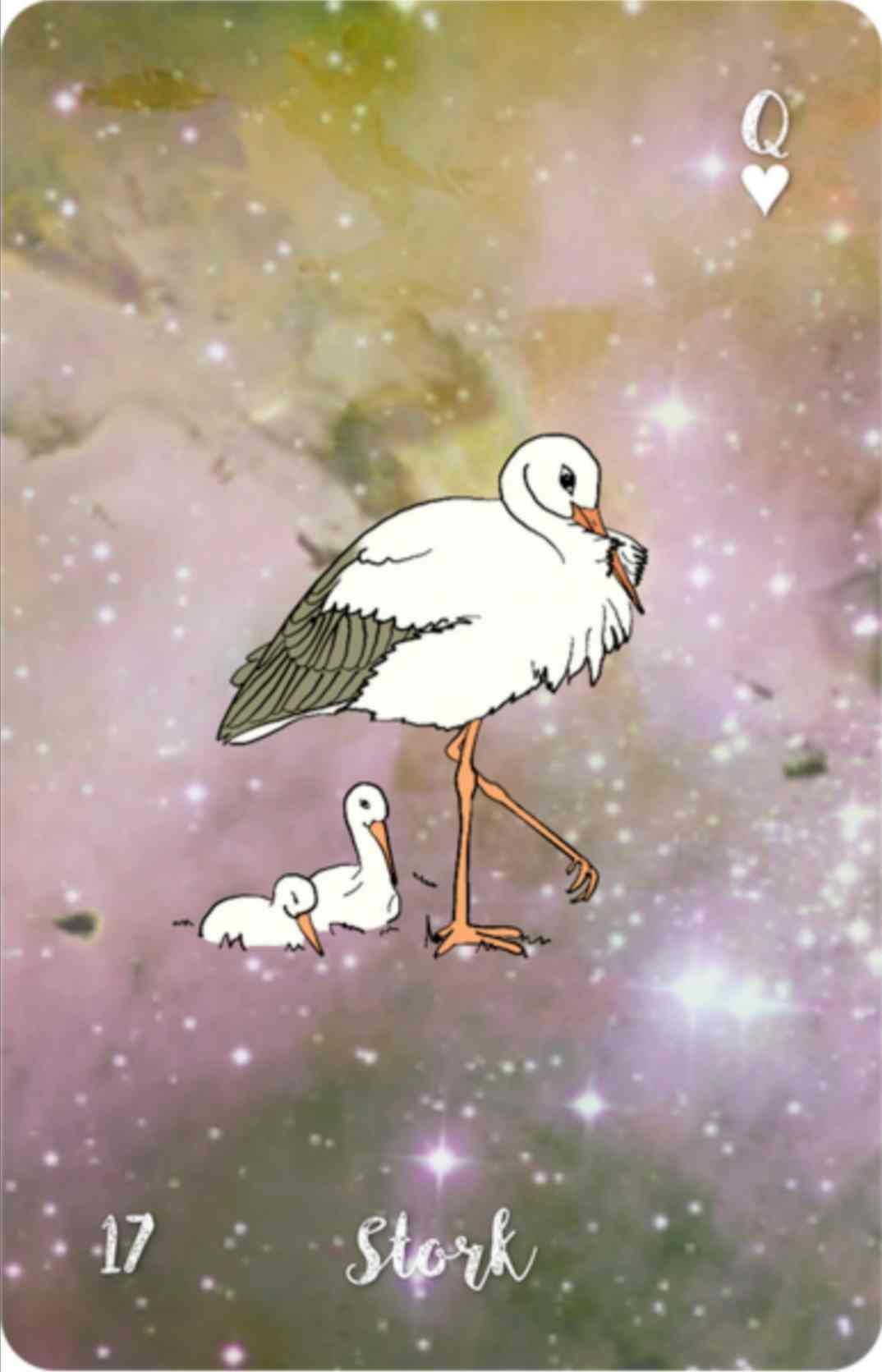
Stork card meaning at a glance
The Lenormand Stork (card 17) stands for change, progress, relocation and the momentum of entering a new stage; things may gradually move on from where they are. It calls for active adjustment and a planned transition, and the neighbouring cards show which direction the change takes.
- Core
- Change, progress, relocation
- Love
- The relationship enters a new stage; agree on the pace first.
- Career and money
- A good time to adjust your career or work location; set aside room for transition costs.
- Yes or no
- Leans yes. Welcome the change, but plan the transition first.
Yes-or-no answers follow the card's general tendency on its own; always read them together with the question and the neighbouring cards.
Basic meaning and symbolism of the Stork
The Stork is card 17 in the Lenormand deck, and its core imagery comes from how storks behave in nature: they migrate every year, bring new life and mark the turning of the seasons. In European folklore the stork is the bird that delivers babies, a sign of birth and arrival, while its migrating habits make it the most intuitive symbol of movement and change. The Lenormand reading system puts great weight on concrete, everyday images, and in that context the Stork points to changes that actually happen, not abstract inner transformation.
The Stork's core keywords are change, progress and a new chapter, but there are subtle layers behind these three words. Change stresses a shift of state, which may be a move in your surroundings, relationships or identity. Progress suggests that this change usually carries upward momentum rather than going round in circles. A new chapter tells the querent that an old cycle is ending and a new one is about to begin. Overall, the Stork is a positive, dynamic card, and when it appears it is often a sign of good news.
- Core keywords: change, progress, new chapter, movement, renewal
- A positive, dynamic card: change usually heads in a better direction
- Symbolizes cyclical renewal rather than a sudden shock
- Closely tied to life cycles, the changing seasons and new life
- An "action" card in the Lenormand system, showing that things are moving forward
Traditional imagery of the Stork card
On traditional Lenormand cards the stork is usually shown standing on one leg or flying with wings spread, sometimes with a nest or a waterside in the background. Standing on one leg suggests balanced readiness, able to take off at any moment; spread wings point directly to action and movement. The corner of the card usually carries a matching playing-card symbol (the Jack of Clubs). In traditional Lenormand reading the Jack of Clubs is sometimes linked to a young man or to passing on messages, but modern readings put less weight on this link and return to the symbolism of the stork itself.
How the Stork differs from other cards of change
The Stork is not the only Lenormand card tied to change. The Ship (3) stands for travel and long journeys, the Bear (15) for strength and stability, while the Stork's kind of change stresses cyclical renewal and natural progress. The Stork's change is not a sudden blow; like the migration of birds, it has its own rhythm and direction. That makes the Stork's change feel more like "the time has come and things are moving by themselves" than a shift forced from outside.
The Stork in love readings
In love readings, the Stork is usually an encouraging sign. If your love life has stalled, the Stork suggests that the relationship is about to gain new momentum, perhaps moving to its next stage, such as from flirting to making it official, or from dating to moving in together or marriage. If you are single, the Stork hints that your love life is about to change: a new meeting or a rekindled old flame are both possible. The key point is that the change the Stork brings in love is usually the kind you have long been hoping for.
Of course, in love the Stork can also point to separation or a relationship changing form, but this kind of ending usually lets each person move into a new stage that suits them better. Lenormand readings depend on the surrounding cards: if the Stork sits next to the Coffin (8) or the Cross (36), the change may carry more sense of an ending; next to the Heart (24) or the Ring (25), the sense of progress and commitment in love is stronger.
- A stalled relationship: new momentum is on the way
- Single: your love life is about to change, and a new meeting is likely
- A stable relationship: a sign of moving to the next stage of commitment
- With the Heart (24): love progresses smoothly and feelings deepen
- With the Ring (25): a sign of engagement or a formal commitment
- With the Coffin (8): a relationship ends, but this also prepares a new beginning
What the Stork says for different relationship situations
For someone single, drawing the Stork means a dry spell in love is about to end and new connections are forming; stay open and take part in social activities. For someone in a relationship, the Stork may signal a new milestone, such as making plans together, moving in or talking about the future. In a long-term relationship, the Stork can also mean that both partners need to bring something fresh into it, rekindling passion by trying new things together.
The Stork in career and money readings
In career readings, the Stork is a strong sign of a career step up and a change in your work environment. It may stand for a promotion, a new job, a change of career path or a change of workplace (for example, a posting elsewhere or a chance to work remotely). The Stork's career meaning especially stresses taking the initiative: it does not mean waiting for opportunities to come knocking, but tells you that now is a good time to act, because the conditions for change are ripe.
For money, the Stork usually stands for an improving financial situation and more cash flow. It may point to a new source of income, a turn for the better in an investment, or a financial plan moving into action. The Stork's money meaning leans more towards dynamic growth than steady accumulation, so in financial decisions it encourages you to seize the moment and act rather than keep waiting and watching. With the Fish (34), the positive money signal becomes even clearer.
- A sign of promotion or a change of position
- A sign that it is a good time to change jobs or careers
- A change in where or how you work
- Finances improve and a new source of income appears
- An investment or financial plan moves into action
- With the Fish (34): finances clearly improve and income grows
The Stork in everyday life
One of the strengths of Lenormand reading is how precisely it describes the details of daily life. In everyday life, the Stork's most common concrete meanings include moving house, renovating, changing where you live, or a new member joining the family (pregnancy or the arrival of a baby). These are the Stork's most traditional and direct images. If you have recently been thinking about moving or family plans, the Stork appearing is a positive confirmation.
Besides changes at home, the Stork can also point to renewing your daily habits and lifestyle, for example starting a new fitness plan, changing your diet, trying a new course or adjusting your daily routine. Seen through the Stork, these seemingly small changes are all concrete signs of personal progress. The Stork reminds us that change does not have to be earth-shaking: steady small updates are also a force for progress.
- A concrete sign of moving house or changing where you live
- A family grows: pregnancy or a new baby
- Renewing habits and daily routines
- Starting new studies or building a new skill
- A sign of travel plans or short trips
- Tidying up your surroundings and replanning your space
Key Stork card combinations
The essence of Lenormand reading lies in how cards combine. As a dynamic card of change, the Stork takes on very different concrete meanings depending on the card next to it. Below are six of the most common and representative Stork combinations, to help you quickly find the right direction in real readings.
The basic rule for reading combinations is this: the Stork supplies the momentum of change, while the card beside it decides which area of life the change happens in, and whether it is positive or calls for caution. So knowing the Stork's combinations means knowing how to apply it across all kinds of life situations.
- Stork + House (4): moving house, a change in living situation
- Stork + Heart (24): love enters a new stage and the relationship deepens
- Stork + Fish (34): finances turn for the better and income grows
- Stork + Coffin (8): an old situation ends to make way for a new beginning
- Stork + Book (26): further study, discovering a new field of knowledge
- Stork + Crossroads (22): an important choice; you actively decide the direction of change
- Stork + Ring (25): progress in a committed relationship, marriage or a contract
- Stork + Ship (3): the possibility of a long journey or moving abroad
Six core card combinations
Stork + House (4): a major change in where or how you live, perhaps a new home, a renovation or a change in family structure. This is one of the Stork's classic combinations and comes up often in everyday readings. Stork + Heart (24): a relationship enters a new stage, the quality of love improves and the bond grows deeper. Stork + Fish (34): a positive turn in your finances, with higher income or investment gains and more money flowing. Stork + Coffin (8): an old situation or relationship comes to an end, but this ending makes a new beginning possible; you need to let go to move forward. Stork + Book (26): learning new knowledge or skills, which may mean further study, exams or exploring a completely new field. Stork + Crossroads (22): you face an important life choice and must actively decide the direction of change; this combination stresses taking the initiative in your choice.
How to make good use of the Stork's message in a reading
When the Stork appears in a reading, the most important attitude is to be ready to welcome change. Lenormand is strongly predictive, and the Stork is usually not asking whether you want to change; it is telling you that change is already on its way. At this point the querent should ask: am I ready for this change? What practical steps can make this transition go more smoothly?
In practice, the Stork's position in a spread also matters. If it falls in a "near future" position, change is about to happen and time feels pressing; in a "distant future" or "outcome" position, the change is where the whole matter is finally heading. Whatever the position, the Stork reminds you that staying flexible and embracing the flow is the best mindset for this card.
- Change is already on its way: prepare to welcome it, not resist it
- Think about concrete steps so the transition goes more smoothly
- Spread position affects timing: a near-future position means it is about to happen
- Staying flexible and open is the Stork's core lesson
- Combine it with the surrounding cards to see which area of life the change affects
FAQ
Does the Stork always mean a good change?
Overall the Stork is a positive, dynamic card, and in most cases it means change in a better direction. But Lenormand readings must take the surrounding cards into account: the Stork itself supplies the momentum of change, while the nature of that change (positive or calling for caution) is shaped by the cards beside it. For example, with the Sun (31) the change brings success and brightness; with the Clouds (6) it suggests obstacles or uncertainty along the way. So the Stork is a good card, but you still need to read it in the context of the whole spread.
Does the Stork in a love reading mean a breakup?
In love, the Stork mainly stands for a transformation of the relationship, not a breakup as such. Its more common meaning is that the relationship enters a new stage, for example getting more serious, making new commitments to each other or changing how you relate. Only when the Stork sits next to cards of ending such as the Coffin (8) or the Cross (36) is it more likely to point to a relationship ending. Even then, an ending in Lenormand often also means making way for a new beginning, and is not necessarily a purely negative outcome. Read it within the context of the whole spread.
The Stork and the Ship (3) both mean movement. What is the difference?
That is a good question. The Ship (3) stresses physical movement through travel and long journeys, usually pointing to going abroad, long-distance trips or things that cross great distances, with an image of leaving familiar surroundings for faraway places. The Stork's movement leans more towards life-cycle renewal and progress from one stage to the next; its change is cyclical and rhythmic, more like a transition between chapters of life. Put simply: the Ship is movement in space, the Stork is movement in time and circumstances. When both cards appear together, they may mean that travel or relocation brings a major life change.
What does it mean if I draw the Stork in several readings in a row?
Drawing the same card repeatedly is a signal worth noticing in Lenormand reading. If you keep drawing the Stork, change is usually the central theme of your life right now, and the energy of that change is very strong; you may already feel that some things in your life are loosening or transforming. Take time to think seriously: which areas of your life are changing, or need to change? Are you resisting a change that ought to happen? The Stork's repeated appearance is often a reminder not to miss the window of time for this change.