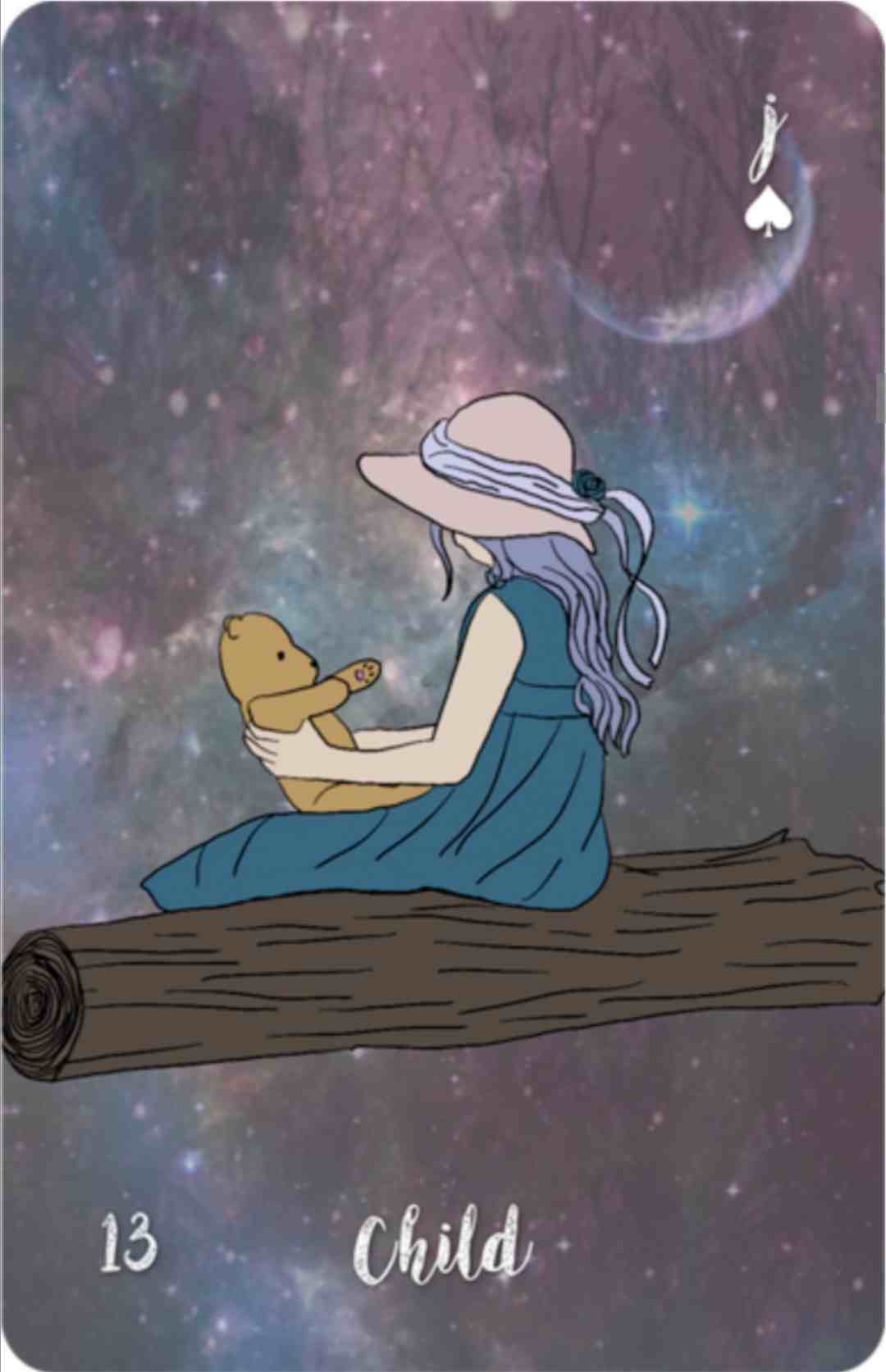
Child card meaning at a glance
The Lenormand Child card (13) represents new beginnings, innocence, small things and a stage that is still learning: there is room to grow, but nothing is mature yet. It reminds you to give things time and proper care instead of demanding a finished result too soon.
- Core
- New beginnings, innocence, learning
- Love
- The relationship is just starting; leave room to explore and grow.
- Career & money
- Put a small amount into new projects first; income still needs time to settle.
- Yes or no
- Leans yes. Start with small steps and don't rush to lock things in.
Yes/no answers follow the card's general tendency on its own; always read them together with the question and the neighbouring cards.
Basic symbolism and core meaning of the Child card
The Lenormand Child is card number 13. It usually shows a young child, symbolising purity, innocence and things that have only just begun to sprout. The core energy of this card revolves around new beginnings: not a carefully planned, fully prepared departure, but a start that carries a little naivety and a little uncertainty, yet is full of possibility. It reminds us that some things are at their very first stage and need patience while they slowly grow. If you want to draw cards for your own question and see what message the Child forms with its neighbours, you can start with an online Lenormand reading.
The Child card also carries the idea of smallness: small matters, small scale, small steps forward. In the Lenormand system this card passes no judgement; it simply shows the current state of something as it is: still small, still tender, still developing. That is not a bad thing. It actually means flexibility and room to shape it. When the Child appears, it often signals that the situation you face has not yet taken its final form, and you still have room to guide it in the direction you want.
- New beginnings, first steps, the budding stage
- Innocence, naivety, no hidden agenda
- Small matters, small scale, small steps
- Youth, children, new life
- Highly adaptable, not yet set in shape
- An open mind, curiosity
Traditional symbols of the Child card
In traditional Lenormand decks, the Child card often shows a small child in old-fashioned clothes, sometimes holding a toy or standing outdoors. These visual elements reinforce the ideas of innocence and beginnings. A child carries no worldly baggage and does not know how to scheme, and that is the heart of this card: meeting what is in front of you with open, uncoloured eyes.
Child card keywords at a glance
Knowing the Child card's keywords helps you quickly place its role in a complex spread. Its energy is light and soft, without a strong sense of fate; it mostly describes a state or a stage.
The Child card in love readings
In love, the most common reading of the Child card is the early stage of a relationship: two people have just met, are still feeling each other out, and the bond is not yet steady. This stage is exciting, but it also carries a touch of uncertainty. When the Child shows up in a love question, it often means the relationship is still fresh, and both people need to give each other time and space so feelings can develop naturally, rather than rushing to define or push things forward.
For couples already together, the Child may hint that something new has entered the relationship: perhaps a new shared plan, a chance to start over, or a return to that first pure, uncomplicated feeling. Sometimes the card also points directly to the literal image of a child. In spreads about having children or family planning, the appearance of the Child is often a signal worth paying attention to.
- Early romance, the flirting stage
- The relationship is not yet steady and needs time to grow
- Simple affection without complicated motives
- May hint at a newborn or questions of having children
- A fresh start in love, returning to how it began
Love advice for singles
For singles, the Child card is a gentle encouragement. It says: the seed of love has been planted, or soon will be, but it is not yet time to harvest. Don't be anxious because things are moving slowly; the purity and sweetness of this stage has value of its own. Keep an open heart and let connection unfold naturally.
The Child card in committed relationships
In a stable relationship, the Child card is sometimes a reminder to look at your partner with purer, less calculating eyes. Weariness in love often comes from too many expectations and comparisons. The Child invites you back to the lightness of when you first met, to rediscover the small details in your partner that made your heart skip.
The Child card for career and finances
In career readings, the Child card usually represents the start of a new project, a job you have just begun, or a business idea still in the trial stage. It does not promise instant success or rich rewards. It is more like saying: you are standing at the starting line and the foundations are being laid. What matters most at this stage is not quick results but building solid ground and keeping a learning mindset.
For money, the Child often points to small sums changing hands, or a financial situation that has only just started and is not yet stable. It is not a card of great wealth, but it is not a bad omen either; it simply reflects that the scale is still small. If you are asking about an investment or financial plan, the Child suggests the matter is still at an early stage. Avoid committing too much; testing the waters on a small scale first is the safer approach.
- The early stage of a new job or new project
- A start-up in its early days, still small
- Learning and building experience
- Small finances, income not yet stable
- Not the time for big investments; try small first
Insights for newcomers and career changers
For someone who has just entered a new environment, the Child card is a fitting portrait. In a new place you are like a child, relearning the rules, building relationships and earning trust. This card reminds you not to lose heart over feeling unfamiliar for a while. Everyone was a beginner once; give yourself time to adjust, and what you learn at this stage will become your most solid asset later.
The Child card in everyday life
One of Lenormand's strengths is describing everyday life concretely, and the Child card is no exception. In everyday spreads it may point directly to children in your life: your own children, nieces and nephews, students, or anyone younger. If the question concerns a young person, the Child often simply represents that person.
Beyond specific people, the Child card in daily life often stands for the energy of trying something new. Have you recently picked up a new hobby? Signed up for a class? Tried a new way of living? These are all everyday expressions of the Child. It encourages you to stay curious and not give up on new things because of thoughts like 'I'm not good at this' or 'I'm too old'. Every new beginning deserves to be taken seriously.
- Children and young people in your life
- New interests, new attempts
- A beginner's mindset
- Small everyday matters
- Family events involving children
Key Child card combinations
The essence of Lenormand reading lies in how cards combine. A single card's meaning is only the starting point; the neighbouring cards tell the full story. Paired with different cards, the Child takes on very different faces: sometimes a lovely new beginning, sometimes childish behaviour that calls for caution, and sometimes a specific child or young person in your life.
Below are the most common and most representative Child card combinations. Understanding them helps you read the message of a spread faster and more accurately in real readings. Each combination has its own context, so apply them flexibly to the background of the question rather than memorising fixed answers.
- Child + Heart: a new romance is budding, the start of pure feelings
- Child + Book: learning something new, beginning a new learning journey
- Child + House: a new member in the family, or the early stage of moving into a new home
- Child + Coffin: a new beginning meets obstacles; the plan may fail early or need to pause
- Child + Stars: a hopeful new plan for the future, a dream beginning to sprout
- Child + Fox: be careful; deception or dishonesty may be part of this new beginning
- Child + Bouquet: new joy and surprises, perhaps an unexpected gift or good news
- Child + Cross: a new beginning comes with challenges or responsibilities and a certain amount of pressure
Child card + Sun card
The Child with the Sun is a hopeful pairing. The Sun brings success and light, the Child brings a new beginning, and together they mean a new plan or new relationship will develop smoothly with a bright outlook. In love this combination often points to a pure and happy new romance; in career it suggests a new project will turn out well.
Child card + Snake card
This combination calls for extra attention. The Snake stands for complications, deception or danger, and when it meets the Child's innocence it often hints that a seemingly harmless new beginning hides risks, or that someone is taking advantage of your naivety and trust. In love there may be dishonesty within the relationship; in everyday life it reminds you to stay somewhat alert to new people and new opportunities.
How to use the Child card flexibly in a spread
In real readings, the Child card's position matters as much as the cards around it. If the Child appears at the centre of a spread, it is often the core theme of the whole question: the matter itself is at an early stage, or the key is how to face a new beginning. If it appears at the edge or in the outcome position, it may suggest that the final direction is a new starting point rather than an ending.
Lenormand emphasises concreteness, and the Child is no exception. When reading it, don't stop at the abstract idea of a new beginning; ask yourself what exactly this new beginning is. A person, an event or a state? Combined with the question's background and the surrounding cards, the Child can often give very specific, practical guidance that helps you see the real shape of the situation in front of you.
- Note the Child card's position in the spread
- Make the reading concrete using the question's background
- Watch the influence of the cards on either side
- Distinguish between 'a child as a person' and 'a new beginning as an idea'
FAQ
If the Child card appears in a love reading, does it mean the other person is serious about me?
In love, the Child card describes the stage more than the depth. It says the relationship is still early and fresh; it does not directly answer whether the other person is serious. To judge their sincerity, look at the surrounding cards: paired with the Heart or the Ring, the feelings are more serious; paired with the Fox or the Snake, pay closer attention to their real motives. The Child itself is neutral; it simply shows where the relationship currently stands.
Does the Child card mean an actual child or pregnancy?
In the Lenormand system, the Child card can indeed point directly to a real child, including your own children, children in the family, or questions of pregnancy and having children. When the question itself is about family planning or children, the literal meaning of this card becomes very important. Still, whether to read it literally depends on the question's background and the surrounding cards. If the Bouquet or the Stars also appear in the spread, the chance of pregnancy or new life is higher.
If the Child card shows up in a career reading, does it mean my plan isn't mature enough?
In career readings, the Child describes the current state, not a criticism of your abilities or the quality of your plan. It says the plan or job is still at its starting stage and needs time to develop. That is not a bad thing; every successful venture has gone through a Child stage. What matters is whether you are willing to give it enough time and patience to grow. Rushing for results may be the attitude most worth avoiding at this stage.
How is the Lenormand Child card different from the Fool in tarot?
Both carry the energy of a new beginning, but in different ways. The tarot Fool has a stronger philosophical flavour, symbolising the soul's journey, a leap of faith and embracing the unknown, with wide room for interpretation. The Lenormand Child is more concrete and practical: it describes the small or early state of something in real life, without many layers of symbolism. Lenormand's strength is concrete prediction, and in that system the Child is saying: this matter is still small, still new, still beginning.